
‘The Audition’ with Roxie Mohebbi, Janet Anderson, Masego Pitso, and James Majoos
Photography by Seung Rok l Creative Direction by Lynn Mathuthu l Interview by Lameah Nayeem
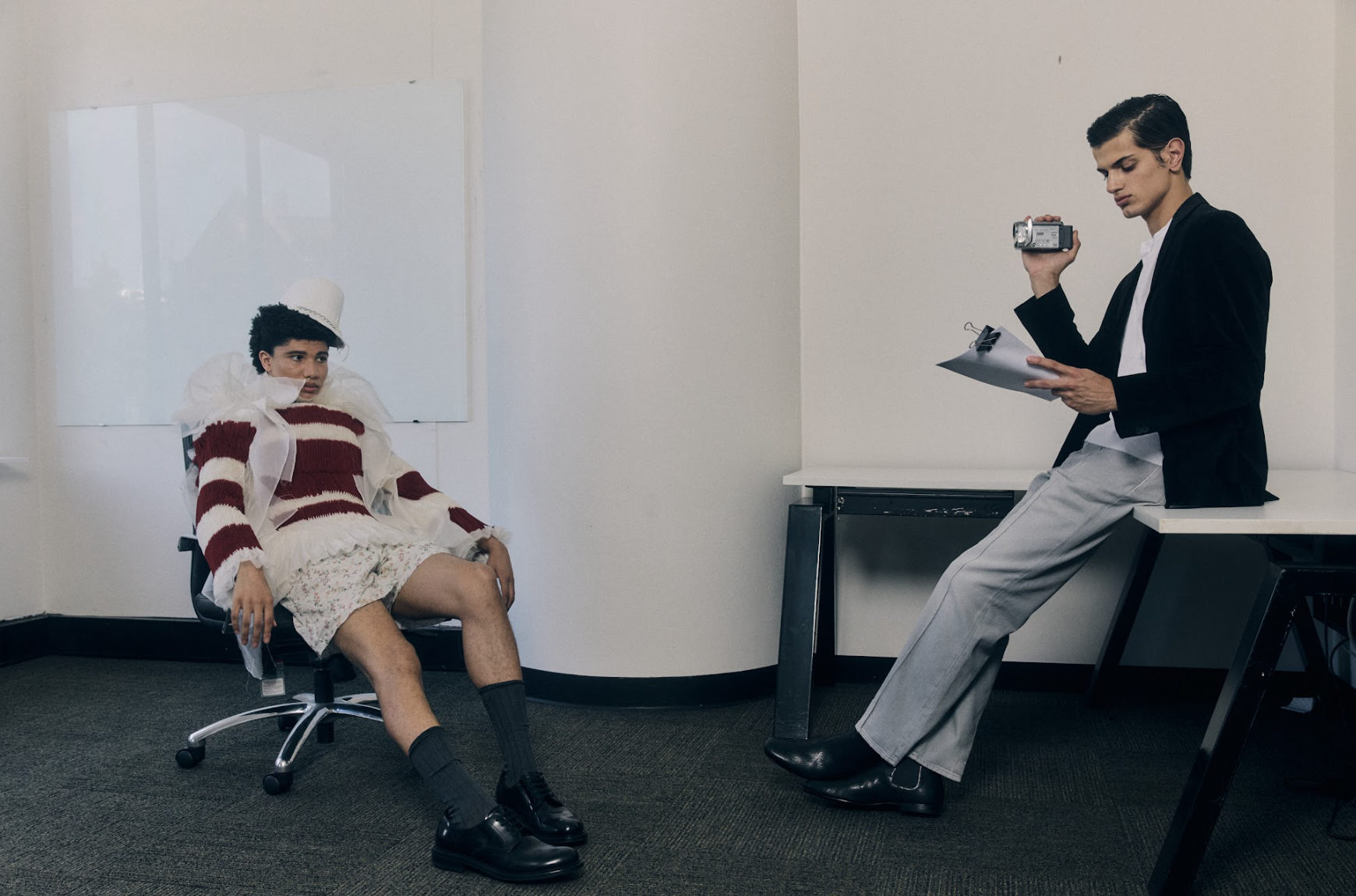
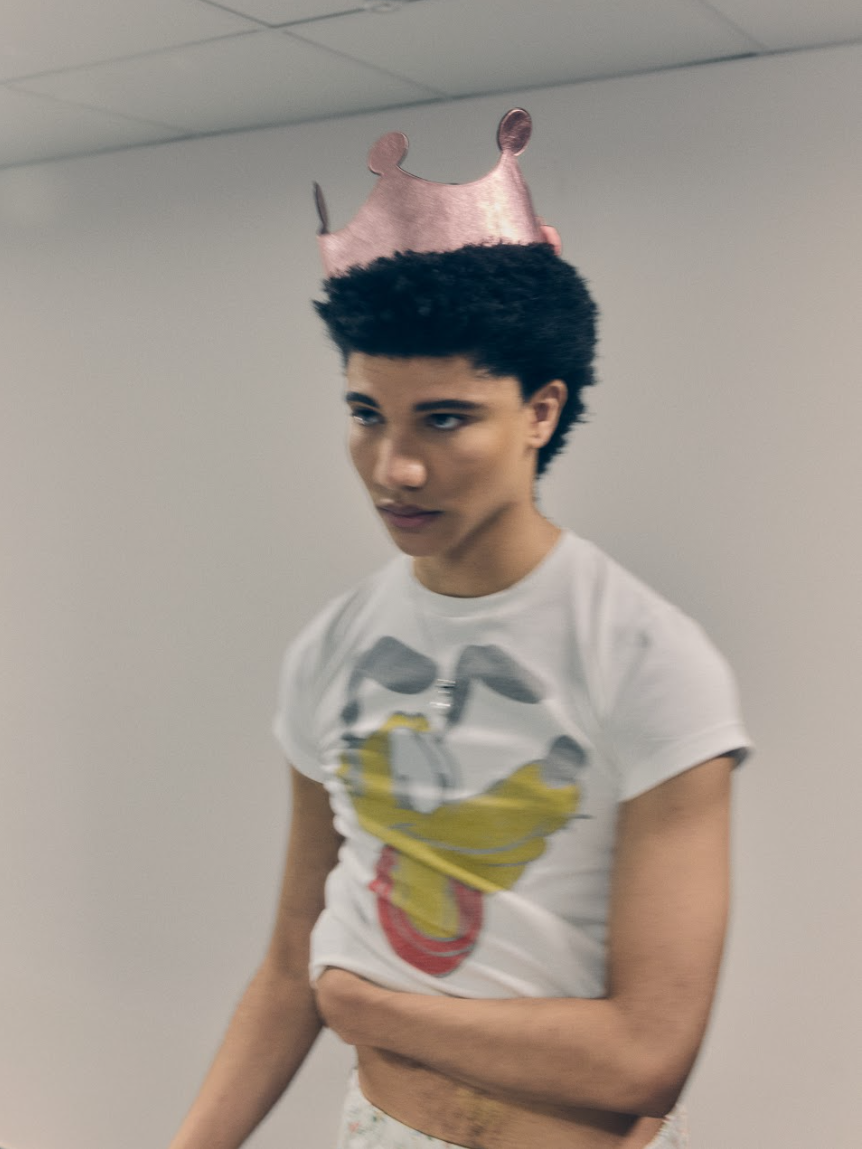
James (left) wears Luke Friend top and shorts, LEAIR hat, Prada shoes. Tom (right) wears Prada.
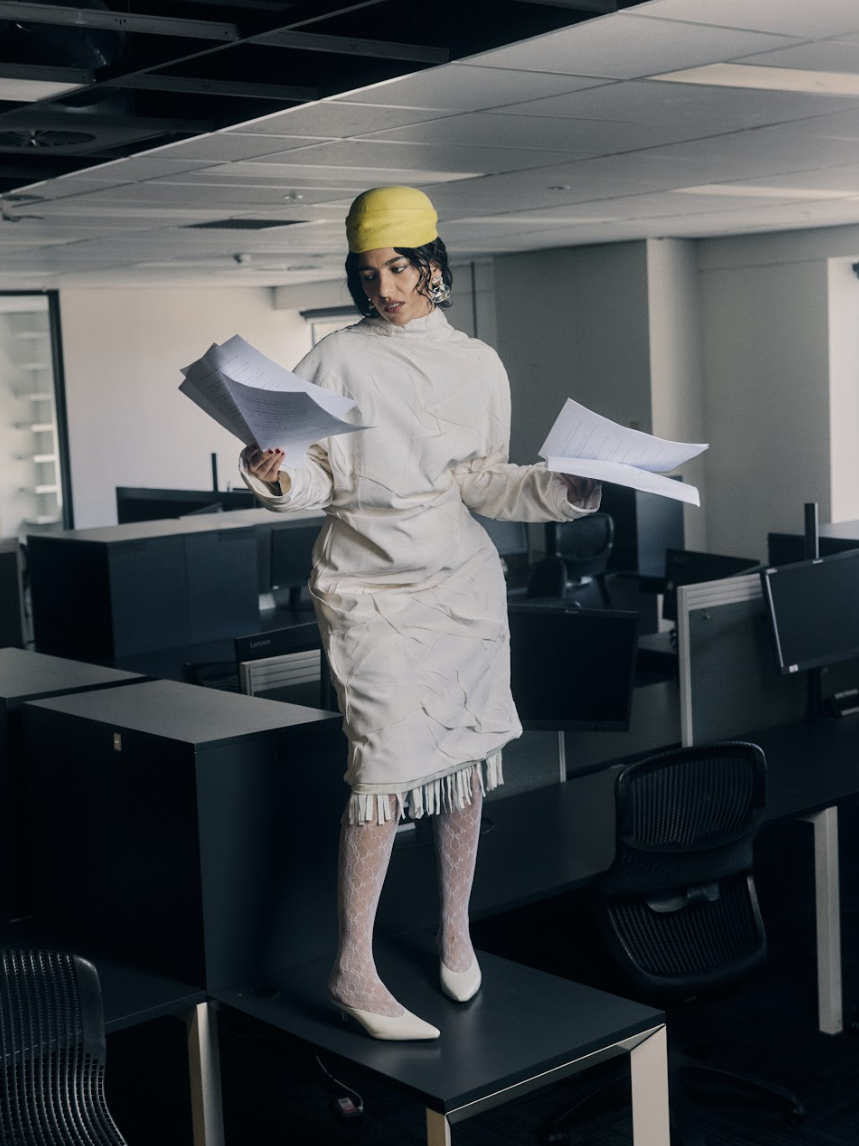
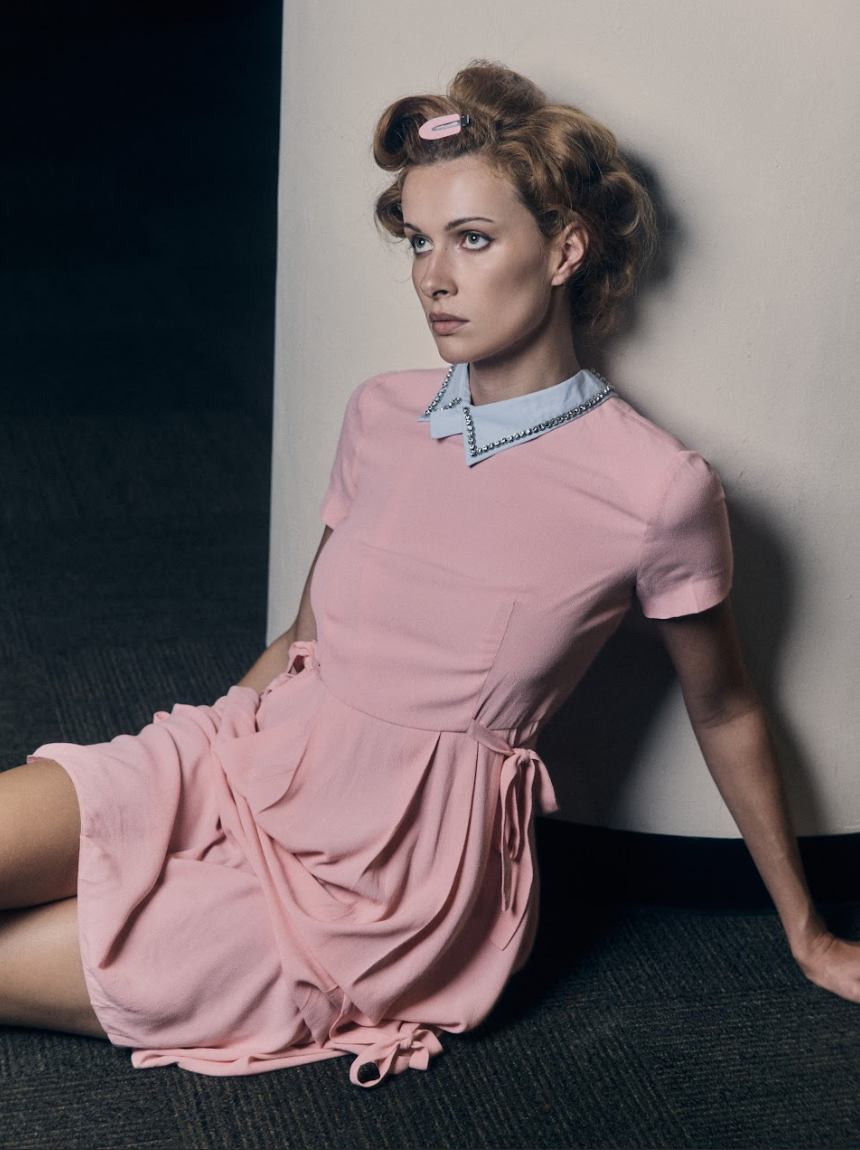
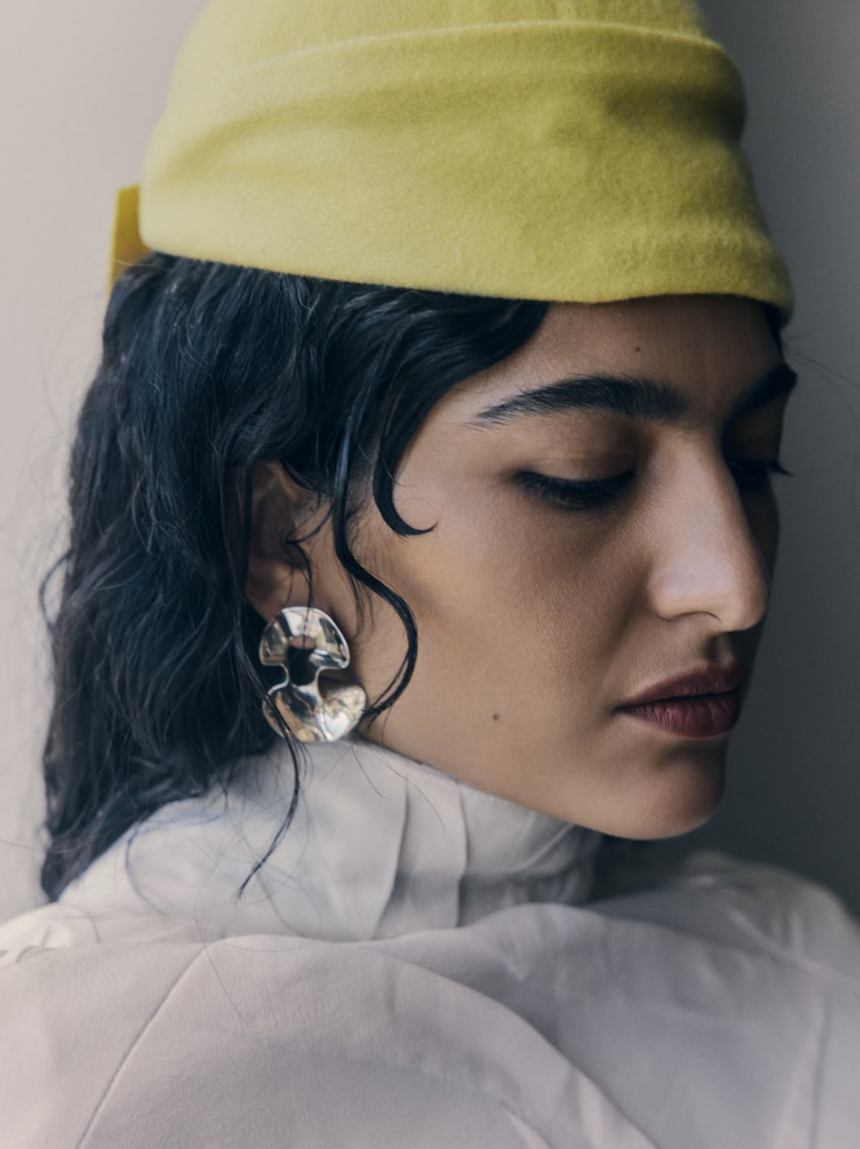
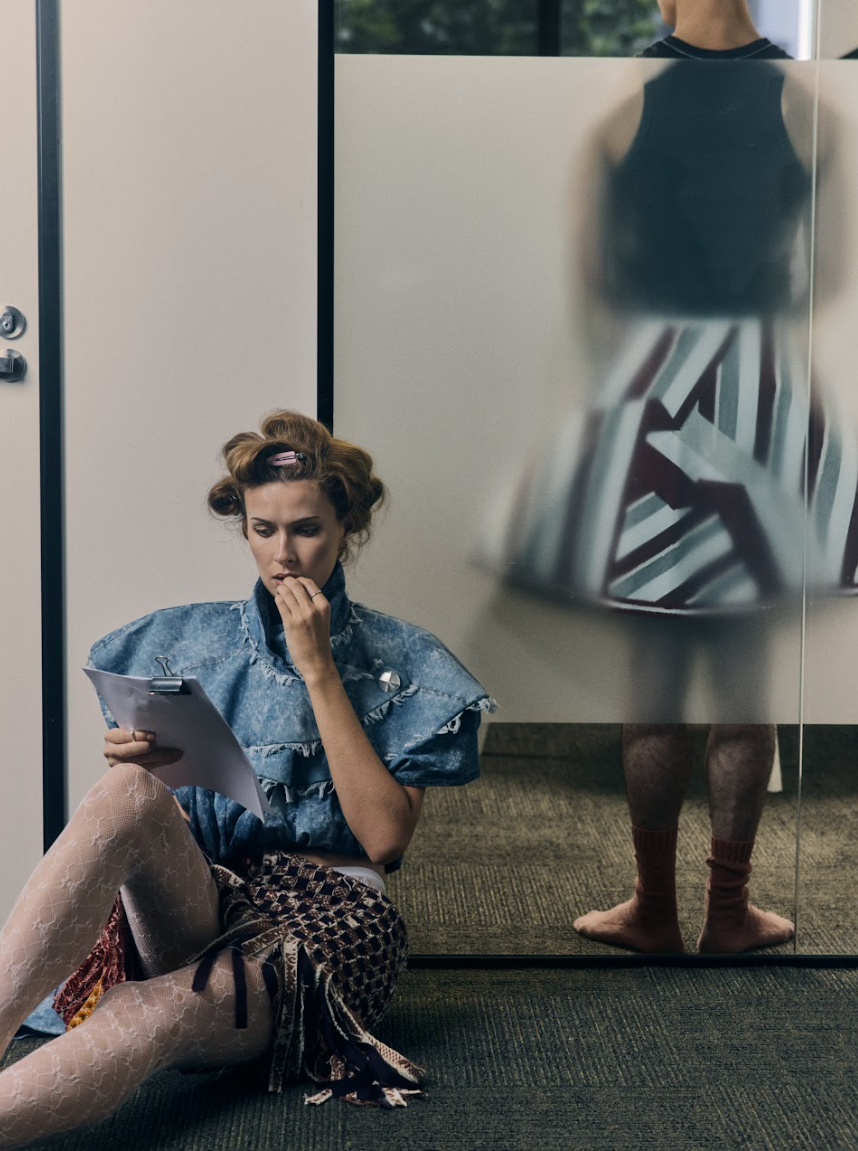
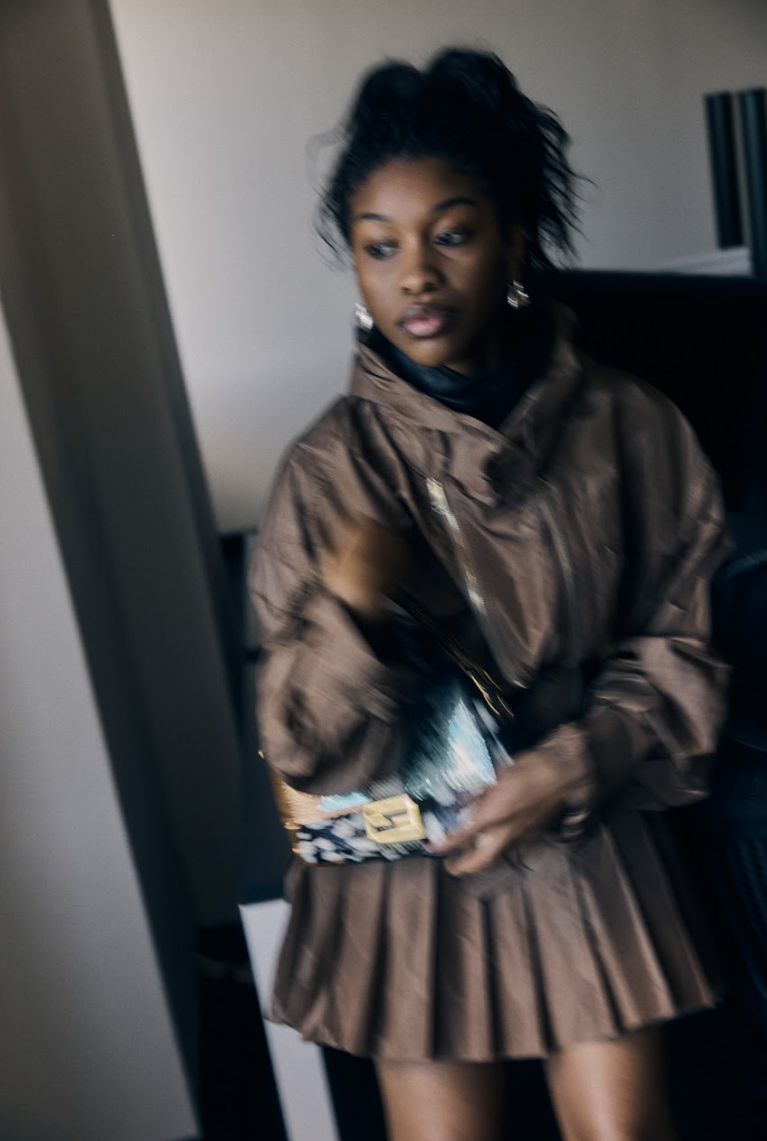
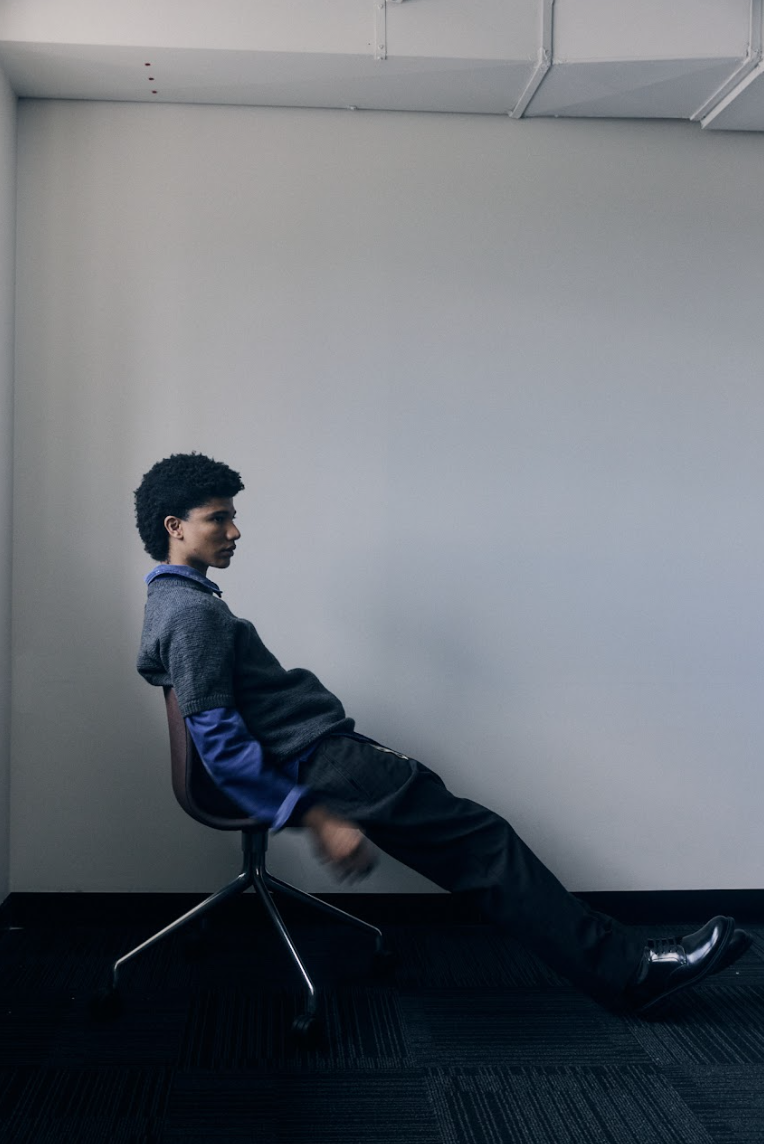
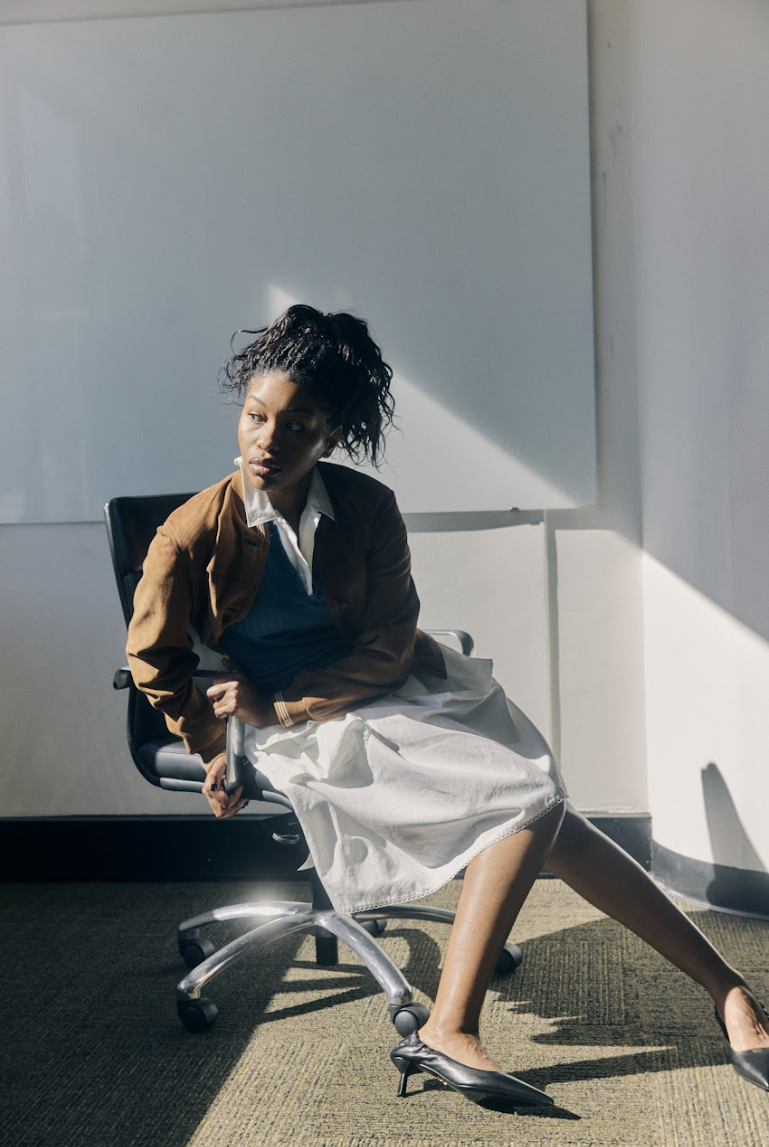
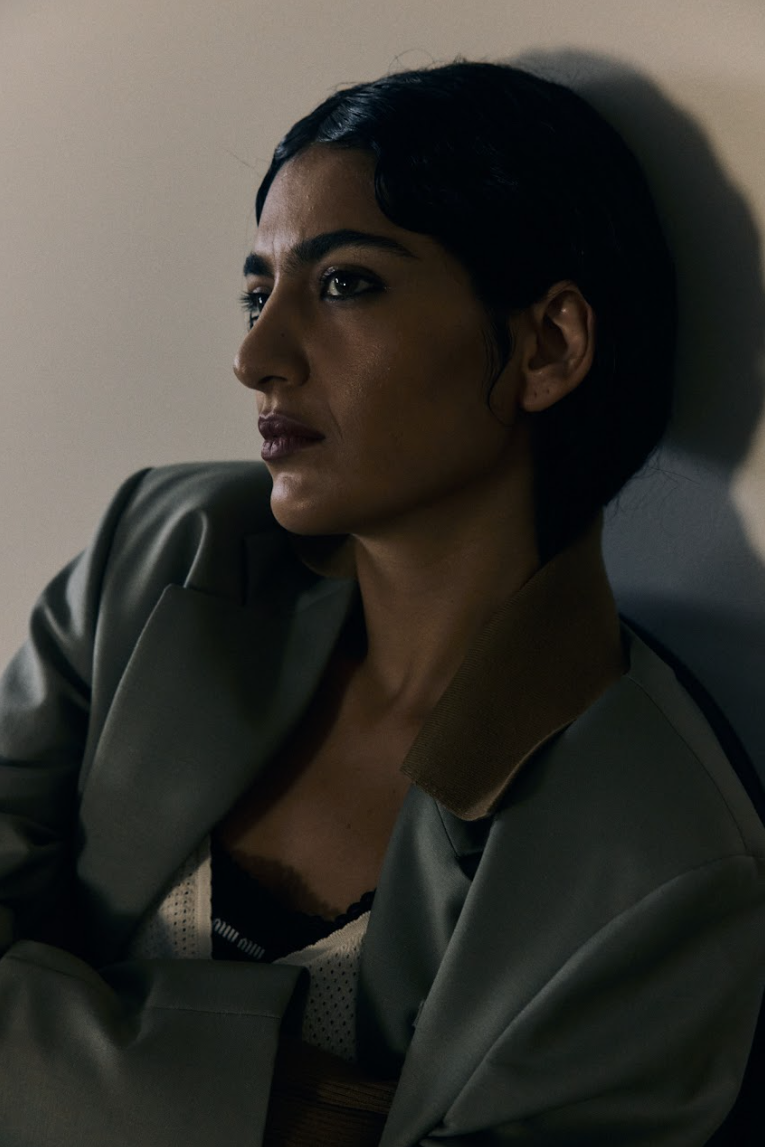
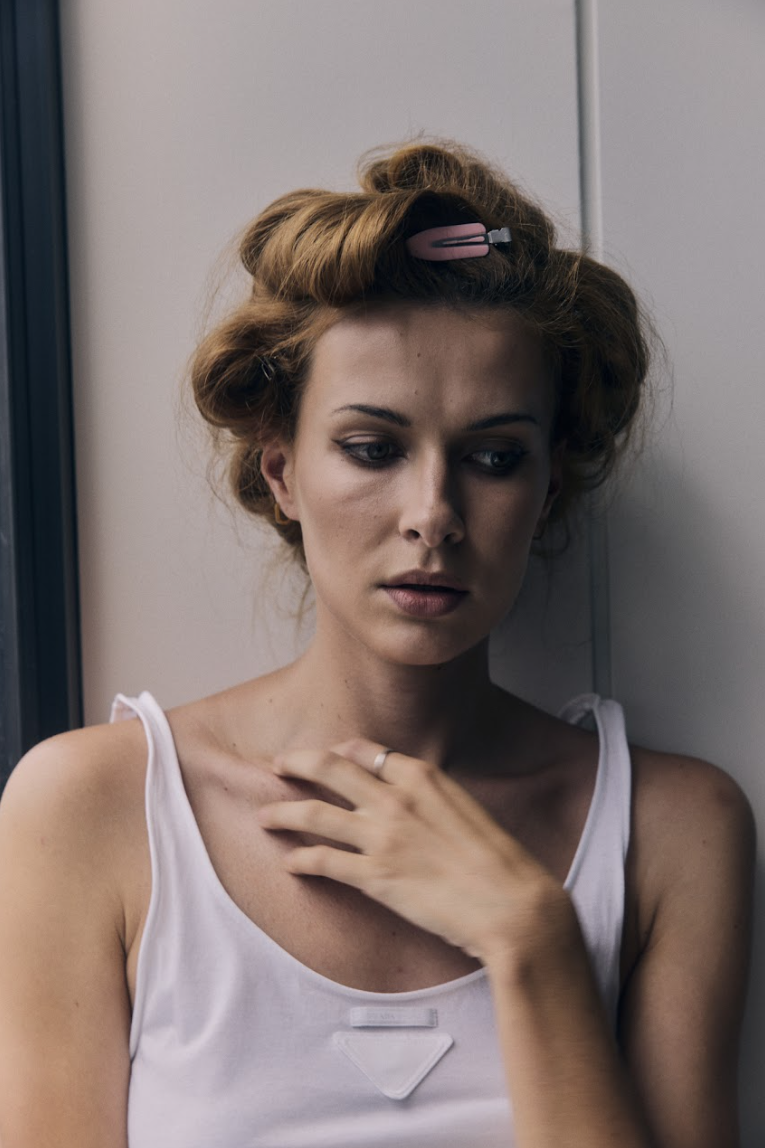
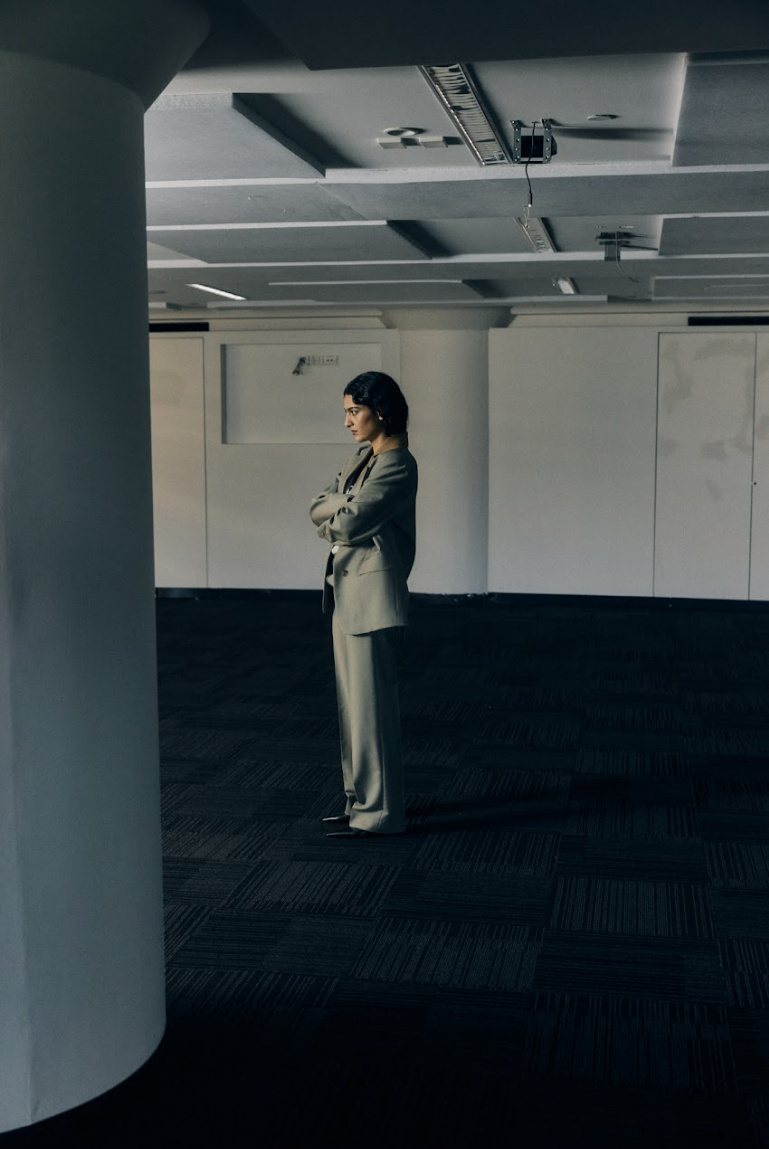
The Audition studies the release of identity and the tension of character immersion through a series of still images. As they wait to be called into the audition room, each actor occupies the fulcrum where character and self face each other from opposite ends of the same axis, threatening to tip either way. Their world is populated by archetypes that flit between our screens and streets — insouciants, beauty queens, jesters — brought to life by Roxie Mohebbi, Janet Anderson, Masego Pitso, and James Majoos. The liminality of the audition room thrusts Mohebbi, Anderson, Pitso and Majoos onto the threshold where performance begins and tapers — or, having entered the industry, never quite ends.
Mohebbi, who stars as Prue in the recent Stan series He Had It Coming and appeared in RUN and New Legend of Monkey, is joined by Majoos, known for his role as Darren Rivers in Netflix’s Heartbreak High, alongside his work in Grand Horizons and Fangirls. Also in conversation are theatre darlings Janet Anderson (Overflow, Paramount Plus’ Last King of the Cross, and co-creator of theatre project SISTREN) and Masego Pitso (Sydney Theatre Company’s 2025 Picnic at Hanging Rock, Chewing Gum Dreams, and Is God Is) who chat with A-M Journal about their craft over email.
1. Is there a specific performance that made you realise you wanted to be an actor?
Roxie Mohebbi: Haha I wish ! I grew up watching Mr. Bean because my Baba thought it was funny. I honestly couldn’t tell you why I wanted to be an actor… from a young age I just didn’t believe in being shy. lol.
Janet Anderson: For me, the roles that made me want to be an actor were the ones that made me jealous — jealous of the fun it looked like they were having, or the sparkly dresses they got to wear. Nicole Kidman in Moulin Rouge was one that lit my fire. One day, I will look as fabulous as that on screen, so help me God.
Masego Pitso: There are performances that moved me, but no singular moment. I knew from a very young age that I wanted to tell stories, to be a vessel and a conduit for them. Growing up watching the likes of Keke Palmer, Robin Williams, Jim Carrey, and Raven-Symoné, I felt a deep yearning and need to be part of those storytelling worlds. It always felt bigger than me, God-ordained.
James Majoos: Not one specific performance, but the feeling of watching someone hold a lot internally. I was always more affected by quiet performances than big ones. The kind where you’re watching someone think in real time. I remember realising that acting wasn’t about pretending to be someone else but about making inner worlds legible. That’s what hooked me.
2. What are the most overlooked aspects of working in film and theatre, whether challenging or rewarding?
RM: The sacrifices you have to make spiritually. It takes a lot from YOU in ways almost any other job doesn’t. You move around a lot, you are always in a state of flux, you disappear for months into a job, you come back up for air and everything around you has changed so you adapt and repeat that cycle. And on a positive, you get to make really special close bonds with the people you work with, which is rare in most other workplaces.
JA: I think your average viewer underestimates the amount of people, money and time it takes to get even one shot on screen. So many people dedicated to making me look juuuuuuust right are sitting just out of frame, and all the viewers get to see is my stellar performance.
MP: The greatest challenge is often one’s mind: being able to quiet it and release yourself from expectations. But that is life, a daily task to release and live. The most rewarding thing about theatre is how alive it is. No performance is the same; it is ever evolving, and that is beautiful. You are able to arrive at each performance to try new things, to go deeper. There is also the energetic relationship between the performers and the audience, which can at times feel electric, and that is unmatched. A friend recently reminded me that theatre is one of the few places where our phones are not included in our collective experience; they are turned off (for those brave enough). Out of sight, out of mind.
JM: How much of the job is waiting. Waiting to be cast, waiting on set, waiting between projects. It requires a strange patience and a tolerance for uncertainty. On the rewarding side, you learn how to be present. When the work is good, you’re surrounded by people paying very close attention to small details, and that can be incredibly grounding.
3. What does getting into character mean to you? Where do ‘you’ go when you’re acting?
RM: I’m constantly changing my perspective on this. Sometimes I feel it’s about having empathy so deep you feel what that character feels in tandem. But I recently watched an interview which spoke about how we as actors aren’t meant to be the ones to feel — the audience is. And that approach feels much less indulgent and honourable somehow. In saying all that, I usually just simply act on instinct.
JA: I’ve always been a talented mimic, having been able to produce pretty top-notch accents and impressions from as early as I can remember. In my head is a kind of reference bank drawn from every performance I’ve loved or admired. Often, when I’m in rehearsal and slowly unpicking a character, these references are what help me make sense of lines. Something as specific as a line delivery from an old Saturday Night Live sketch will leave its mark on me. Any character I play is really an amalgamation of everything I’ve ever consumed.
MP: It is a journey; I go in stages. From the first read, it’s all world-building, collecting information. Once the parameters are clearer, it’s asking questions, and then, once in my body, leaning into the work begins. This process shifts and adapts to each work. Know that the questioning and discovering never stops; for stage especially, things might only click halfway through the season in ways that deepen your understanding of a particular moment, and it’s magical when this happens. It feels like there is a balancing act of surrender to the story while Masego the actor maintains overall control, making sure I’m in my light, that I’ve picked up the correct prop, and that I’m exiting in the right place.
JM: I go into the work and the preparation first and commit to that. But once I’m there, it’s just as much about letting go of it. Letting go of certain aspects of myself so there’s space for the character to sit. I’m not trying to disappear, more like shifting the balance, holding onto what’s useful and releasing what gets in the way.
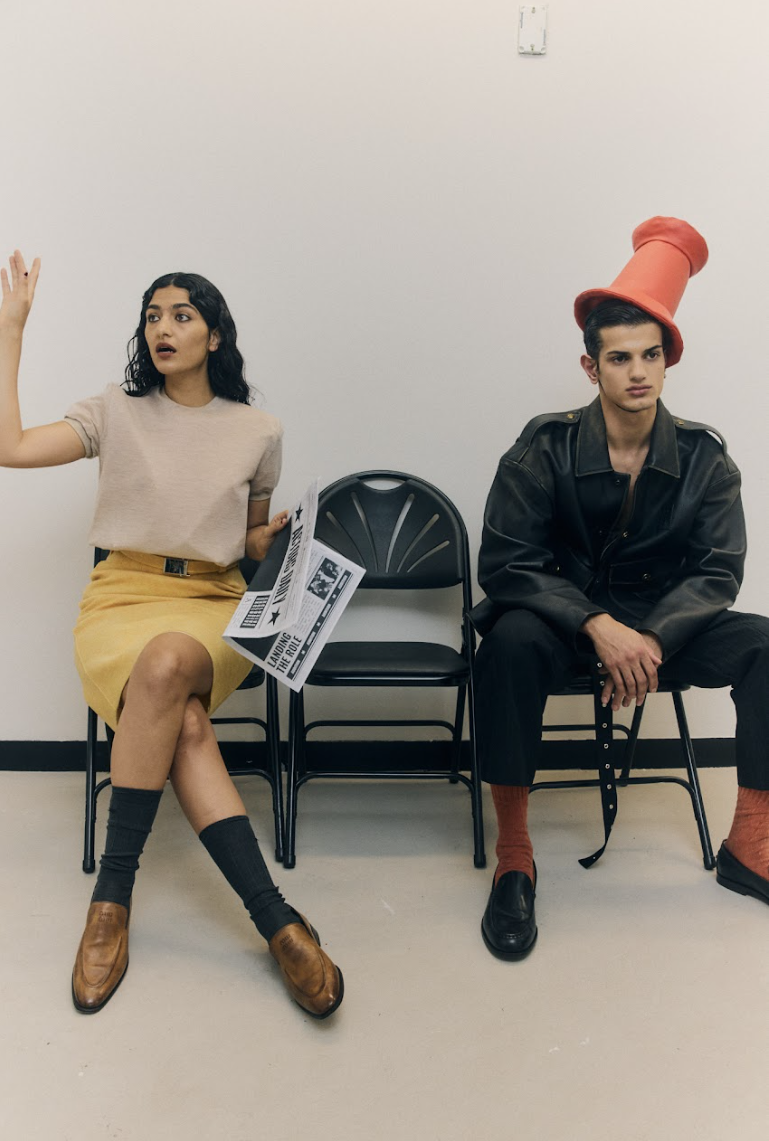
Roxie (left) wears Prada skirt and top, Miu Miu shoes. Tom (right) wears Coach jacket, Strateas Carlucci pants, LEAIR hat, Tod's shoes.
4. What is the most bizarre thing you’ve done to prepare for a role?
RM: I softly lied about being able to do martial arts once and had nine days to learn how to do stunts, MMA & sword fighting from never having thrown a punch. Luckily I have iron will and the film actually won awards!
JA: As lazy as it may sound, I’ve never been one for preparation. Homework is a trigger word for me. That aside, I’m still willing to do anything for the gag. In a one-woman show I did called Overflow, I had to wade through about a foot of cold water in platform boots every night, in front of 200 people, while talking about what it’s like being a trans woman in this current political climate. That’s called dedication to the craft, ladies.
MP: Nothing springs to mind as being bizarre, but I suppose for the muggles, witnessing a performer's warm-up might be bizarre. Oh, there was a season of strategically thrashing the air with a stuffed stocking. Bizarre for those outside the process, but vital for those within.
JM: Probably nothing outwardly bizarre, I think… I mean acting is very bizarre anyway. Obsessively rereading scenes, sitting with the script in silence, overthinking small choices. I think my version of bizarre is internal. I spiral privately and try my best to show up looking very calm.
5. Have you ever played a role that changed you in any way?
RM: I think they all do in their own little or big ways. I always go on a rogue mission to prep for every job I do and find ways of spotlighting that character's life into mine. It exposes me to so many new experiences and new people/communities… which I love. And those experiences are constantly forming my sense of self.
JA: Straight after drama school I co-created a show developed from a script I had come across at the Edinburgh Fringe, Collapsible by Margret Perry, into a live cinema show. It was just me on stage with two camera people and about 60 pages of dialogue. The team was led by a few other NIDA grads (shoutout Zoë, Morgan and the whole Collapsible team), who at times were learning on the job as much as myself. The process was many firsts for me, and it taught me just how much drive it takes to pull off something that ambitious. And even though it was intimidating, stressful, and brought me to tears on multiple occasions, being able to see something through from start to end will always be extra gratifying.
MP: All roles change you, be they great or small; however, Racine from Is God Is by Aleshea Harris — oh, Racine did a number on me. That role allowed me to sit in my rage and disappointment, to feel it and thrash it out (safely), and then released me into what felt like the arms of God. I must also add Ariko from WHO NO KNO GO KNO by Kudakwashe. This entire piece reminded me of our collective breath and the power we all have within us. Life is Ubuntu (an African philosophy meaning 'I am because you are') and for restorative change and healing to occur, we must lean into Sankofa (a Ghanaian term for 'go back and get it'). This means returning to retrieve what was left behind in order to move forward. I now know and trust that my rage is valid, and that there is both power and necessity in returning to the past so we can move ahead.
JM: Not yet, honestly. I might hold onto parts of a character while I’m working, but once production wraps, I’m pretty deliberate about peeling them off and letting them go. I like the separation. That said, I am very aware of the weight a character can carry for people watching. Knowing someone might see a small part of themselves reflected back is something I don’t take lightly, even if I don’t carry the character with me afterward.
6. Can you describe a dream project you’d want to star in?
RM: I want to go overseas!!! I got close to a big job in Italy this month (RIP), but that’s the vision. I want to expand my rogue missions to global ones, haha. I feel I could do some real damage with a little rental car and my friendly attitude in a foreign place while filming something of scale. I’m also just loving all the genre, character-driven indies coming out and relevant, sexy TV like I Love LA.
JA: I always admire productions that spend their money on crew and craft rather than CGI and big name actors. In a perfect world it’s a camp comedy on the West End, with lush costumes, painted backdrops and no straight men.
MP: I dream of being cast in a TV show centred on the lives of Black African-Australian girls, navigating life down under. Think Girlfriends and Insecure but for young adults. A DREAM! Beyond this I have creatives that would be a dream to work with like Mara Brock Akil, Kudakwashe, Shonda Rhimes, Effie Nkrumah, Aleshea Harris, Shari Sebbens, Keke Palmer and Issa Rea.
JM: I don’t have a fixed dream project. I’m most excited by being surprised by a script or a character. The idea that there’s still so much potential out there for something new is what really excites me.
7. What are your Top 4 on Letterboxd?
RM: I change this almost as frequently as my sheets. Currently it’s pretty safe and classic, mildly filmic with a little flair: Close Up (1990), Whale Rider (2002), Incendies (2010), Willy Wonka & The Chocolate Factory (1971).
JA: I think it’s important for your taste to develop as you consume, so my Top Four are incredibly inconsistent. But from the films I’ve watched this year, my picks are: A Matter of Life and Death (1946), Hard Truths (2024), The Wedding Banquet (2025), Oklahoma! (1955) or Hello, Dolly! (1969). I won’t be picking between them, and you can’t make me.
MP: I will have to do a mixture of stage and screen. As it stands it is: 7 Methods of Killing Kylie Jenner (Green Door Theatre Company), The Picture of Dorian Gray (Sydney Theatre Company), Matilda (1996) — that's for me and my grandmother — and Sinners (2025).
JM: I don’t know how to use Letterboxd, I’m sorry. I like to gatekeep my favourite things! They’re for me. Also, I’m so capricious and my favourite films change all the time
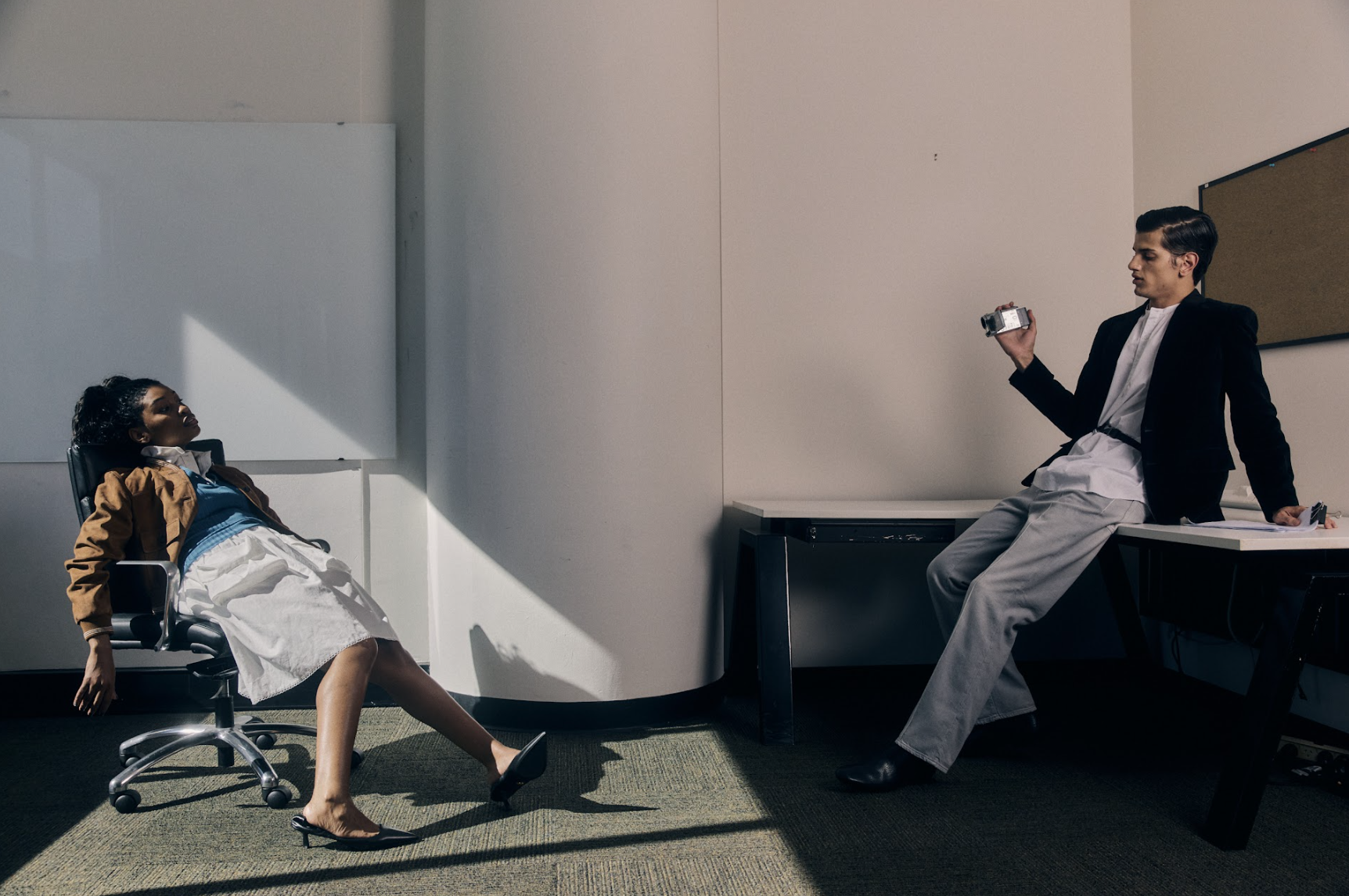
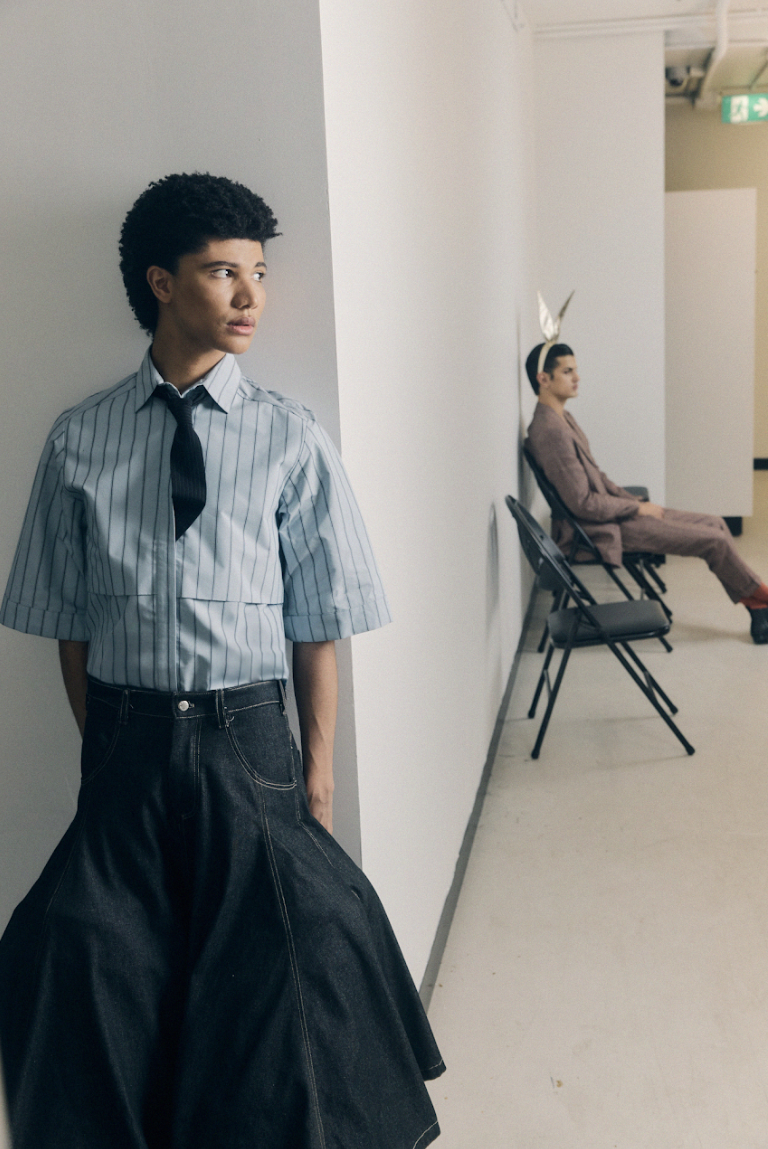
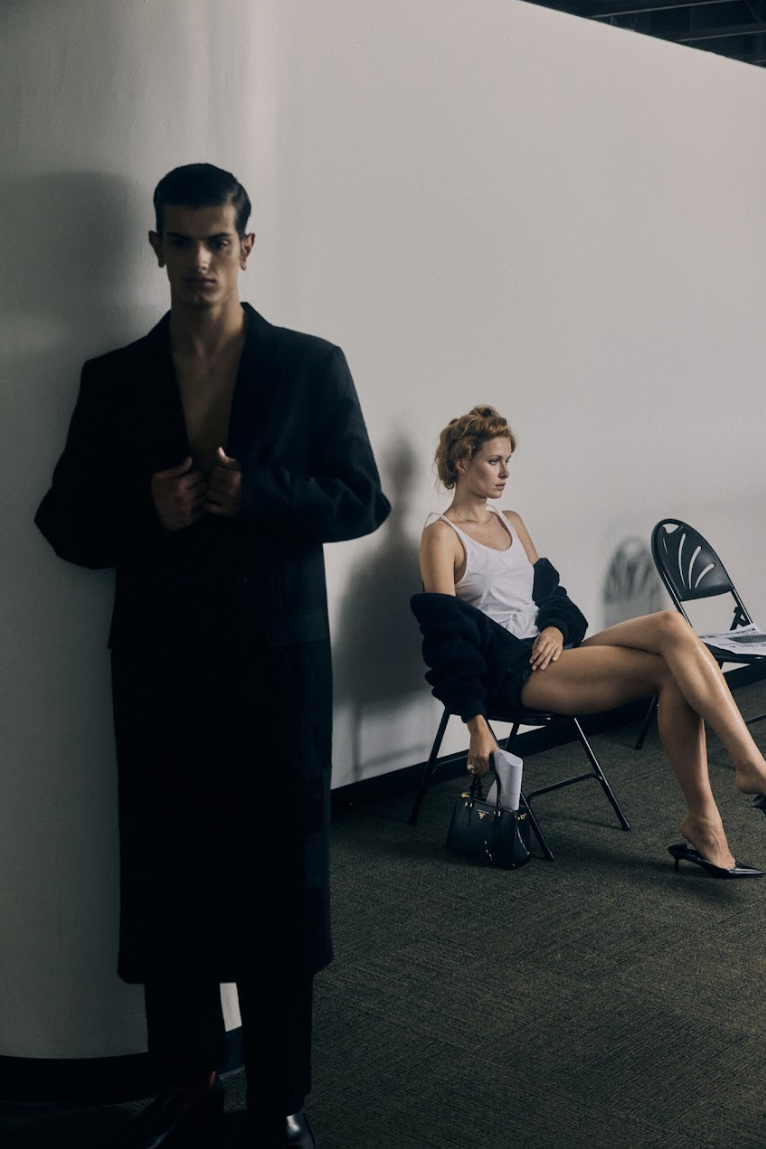
Maesgo (left) wears Miu Miu, Tom (right) wears Prada.
Photography Seung Rok @seung_rok @saundersandcoagency
Fashion Editor & Creative Direction Lynn Mathuthu @lynn.etc
Hair Laura Mazikana @lauramazikana
Makeup Carly Lim @carlylim_makeup
Assist Aria Wood @ariawood__
Digi Bec Seeto @becseeto_photo
Lighting Carissa Anderson @carissa_photography07
Art Director & Production Zoe Holloway @zoeholloway