
Samantha Everton on the Camera as her Stage
Interview by Lila Daly-Hyatt
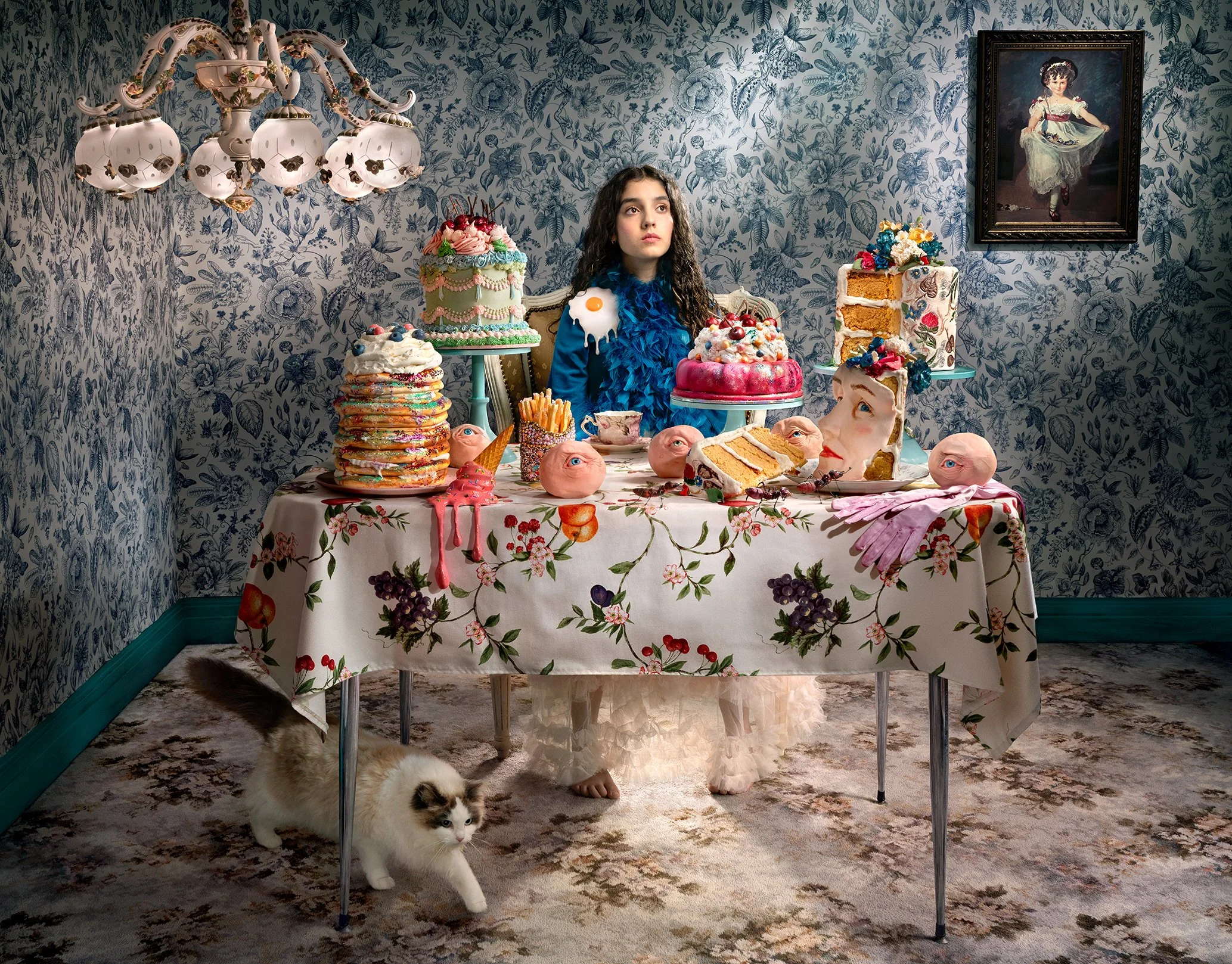
Suite of Desires, pigment ink on cotton rag, 93 x 118 cm
In photographer Samantha Everton’s latest series, Thirteen, elaborate fantasy worlds become a way of looking at the real conditions shaping a generation growing up within cultures of constant consumption. Opening at Arthouse Gallery on the 17th September, Thirteen depicts thirteen-year-old girls in various settings of spectacle, from a table laden with sumptuous cakes to an armchair surrounded by a bevy of kittens and exotic birds. Everton’s detailed tableaux playfully negotiate the tensions of constant visual stimulation and question the cultures of excess that young people have become both inheritors of and active participants in.
In Everton’s photographs, surreal environments unfold, with sets, costumes and props all painstakingly designed, sourced or commissioned by the photographer herself. Though theatrical and playful, beneath all the icing and feathers, Everton’s images set the scene for deeper questioning. What happens when adolescence, a stage of becoming and self-exploration, becomes a site of consumption? Where identity is shaped by conspicuous accumulation, what do we do when abundance leaves us feeling hollow? Visualised through the figures of young people who have never known an alternative, Everton’s surrealist photographs consider the absurdity, and ordinariness, of the contemporary world they have inherited.
Ahead of her upcoming exhibition at Arthouse Gallery, Samantha Everton speaks with A-M Journal about the camera as a stage, the language of theatre and cinema, and the futures we should still believe in.
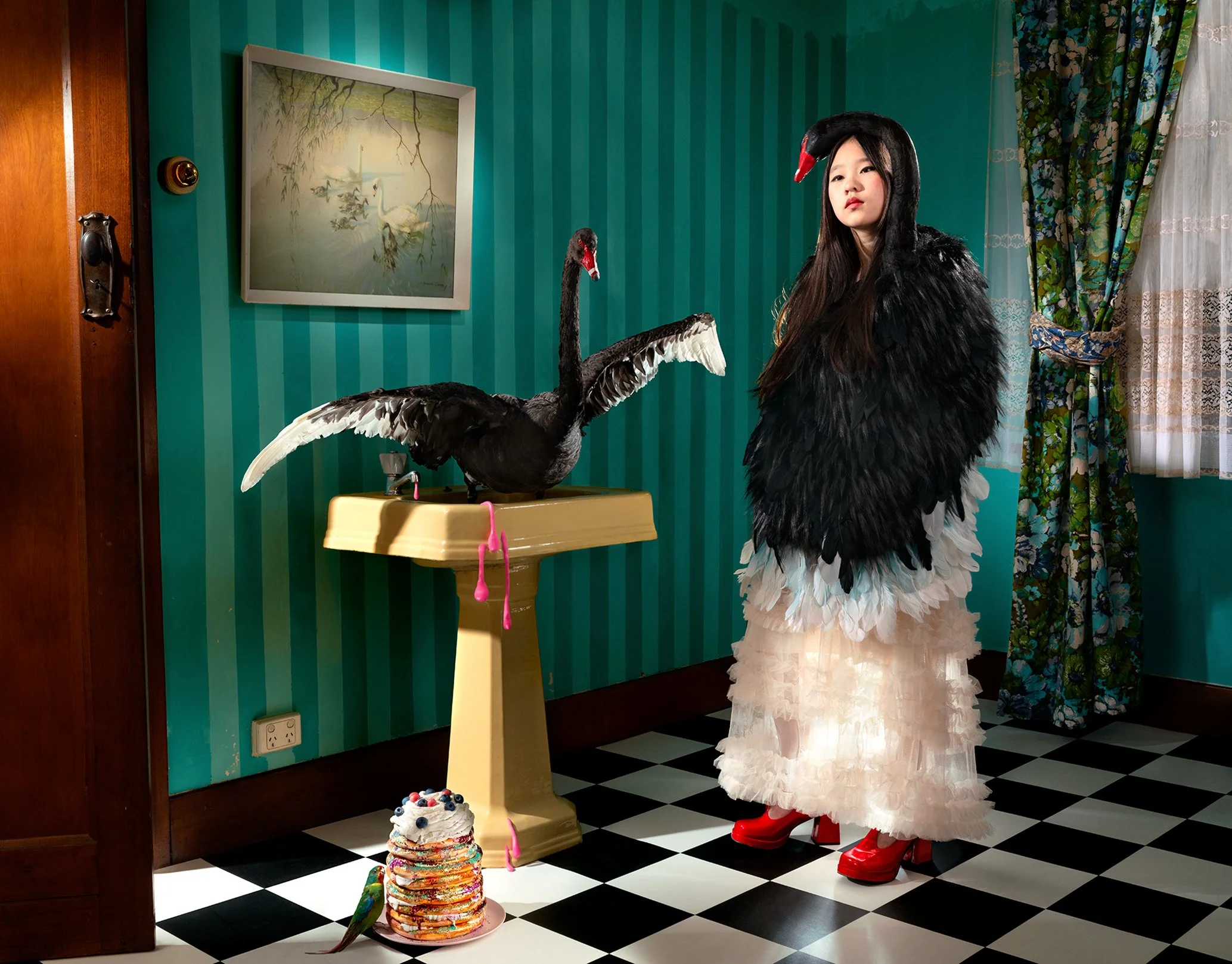
Curated Wilderness, pigment ink on cotton rag, 93 x 118 cm
LILA DALY-HYATT: How did you first get into photography, and what drew you to conceptual portraiture?
SAMANTHA EVERTON: I think my love of surrealism began when I was very young. I discovered Salvador Dalí when I was about eight, and I was completely captivated by the idea that you could paint or draw things that couldn’t possibly exist in the real world —things you couldn’t see, but could somehow imagine into being. It felt like discovering a secret language where there were no rules.
At the same time, I was constantly making things with my hands. I built miniature sets and scenes for my dolls, made lounge suites and chairs from wooden pegs, created little shops from scratch and even made all the products to fill them. I loved the entire process of inventing a world, right down to the smallest detail. I didn’t really care what the medium was, I just wanted to make.
School was difficult for me as I wanted to spend my time making, painting and drawing, and so much of what I was being taught felt disconnected from that instinct. As an adult, I began discovering artists who showed me that this way of thinking could become a language in itself. Jerry Uelsmann’s meticulously constructed darkroom photographs particularly resonated with me — his impossible tableaux of beaches washing into living rooms, or trees growing through floors. Later, I discovered the work of Miranda July and Gregory Crewdson, and their ability to create strange, cinematic worlds that sit somewhere between the ordinary and the surreal.
Photography ultimately became the place where all of these things could come together. It allowed me to build, paint, design, direct and imagine, and then bring all of it in front of the camera. In many ways, I still feel more like a set designer and director than a photographer. The camera became my stage — a place where I could construct worlds that couldn’t exist anywhere else, and make the impossible feel, for a moment, completely real.
I could hang the impossible from the ceiling, use fans to make hair move in an otherwise still environment, manipulate scale, light and perspective, and let my imagination run without boundaries. There was a kind of magic in being able to construct a world entirely from my own imagination, and then freeze it in a single frame. Photography gave me a way to tell stories visually, unabated, and to make the impossible feel briefly real.
LDH: Before your photographs are even taken, each image involves such elaborate costuming, prop making and set building. Why is this form of theatrical production, of constructing these worlds so intricately, important to you?
SE: It’s really my imagination colliding with the world we live in — the absurdity, beauty and complexity of it, as well as the challenges we’re facing. I’m drawn to the language of theatre and cinema, where you can build an entire world from scratch and invite an audience to step inside it. I love constructing these elaborate, surreal environments as a kind of visual stage, where costume, props and set become part of the storytelling.
There’s something playful about creating a world that initially feels fantastical or seductive, and then allowing something more confronting to slowly reveal itself within it. I’m interested in that moment when the viewer moves from looking to questioning. Rather than confronting people head-on, I want to draw them in through beauty, humour and imagination, and let the deeper ideas emerge almost like a second act.
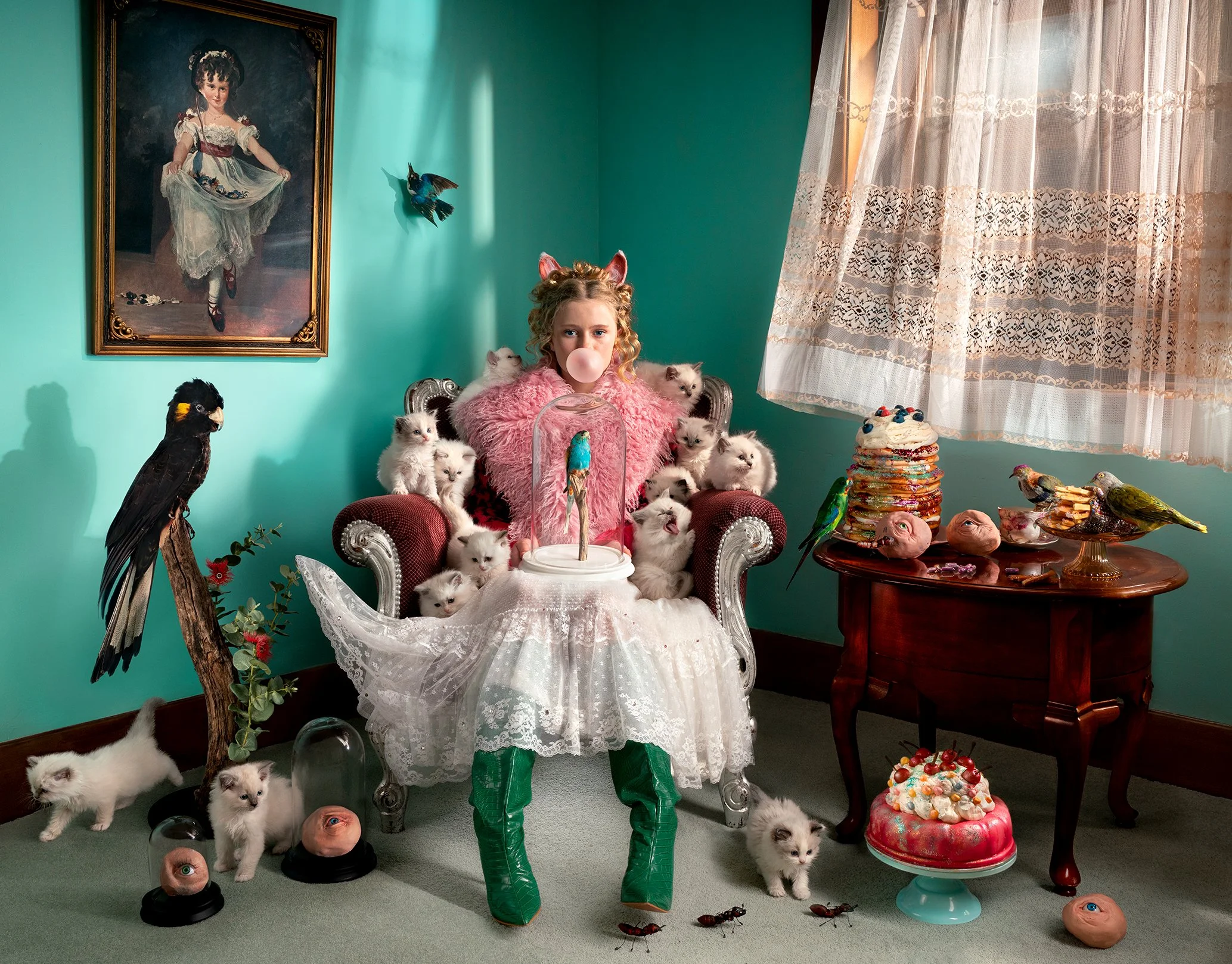
Parlour of Wonders, pigment ink on cotton rag, 93 x 118 cm
LDH: What happens to all the props, sets and costumes once the photographs are taken? Do you have an amazing dress-up box at home?
SE: Indeed I do! I have a rather wonderful dress-up box. But I’m also very conscious of what happens to these objects beyond the photograph. As my understanding of the world and our environmental responsibility has evolved, so has my practice.
I meticulously source almost everything second-hand, through op shops and Facebook Marketplace, or borrow it. I make things from scraps, found materials and whatever I can give another life to, and wherever possible I avoid buying something new simply for a photograph. After a shoot, the props, costumes and sets are passed on to be reused, recycled or repurposed.
There’s something quite beautiful about that process for me — the objects have a life before they enter my imagined world, a moment within the photograph, and then a life beyond it. I want the magic to exist in the image without creating unnecessary waste behind it.
LDH: Why thirteen? Did working with thirteen-year-old girls encourage you to reflect on yourself at this age, and how the world you inherited compares with the one they’re growing up in?
SE: Thirteen is a pivotal age of transition, awakening and awareness — a moment when young people begin to look beyond themselves and become more conscious of the world they are inheriting. This generation is growing up with an unprecedented awareness of climate change, environmental fragility, social inequality and a rapidly changing technological landscape. At thirteen, those realities are no longer abstract; they begin to shape how young people see their future and their place within the world. That made thirteen the right age to explore what this generation is inheriting, and how they are beginning to make sense of it.
LDH: For this series, you’ve also created sculptural figurines that recreate the scenes themselves. What made you want to extend the work beyond the photograph in this way?
SE: For me, it felt like a very natural progression of the story. A photograph captures a single, suspended moment, but I became interested in imagining what happens beyond that frame — who these characters are when they leave the scene, what their world might look like, and how they might continue to exist beyond that captured moment. Creating the figurines allowed me to give these imagined characters another kind of life. They become almost like small actors who have stepped out of the photograph and into the physical world. There’s something quite magical about that shift.
It’s also a creative and technical challenge. Moving from photography into sculpture means learning to think about the work in three dimensions — form, texture, scale and material. I love that challenge. It pushes the work into unfamiliar territory and allows the story to keep evolving rather than ending when the shutter closes.
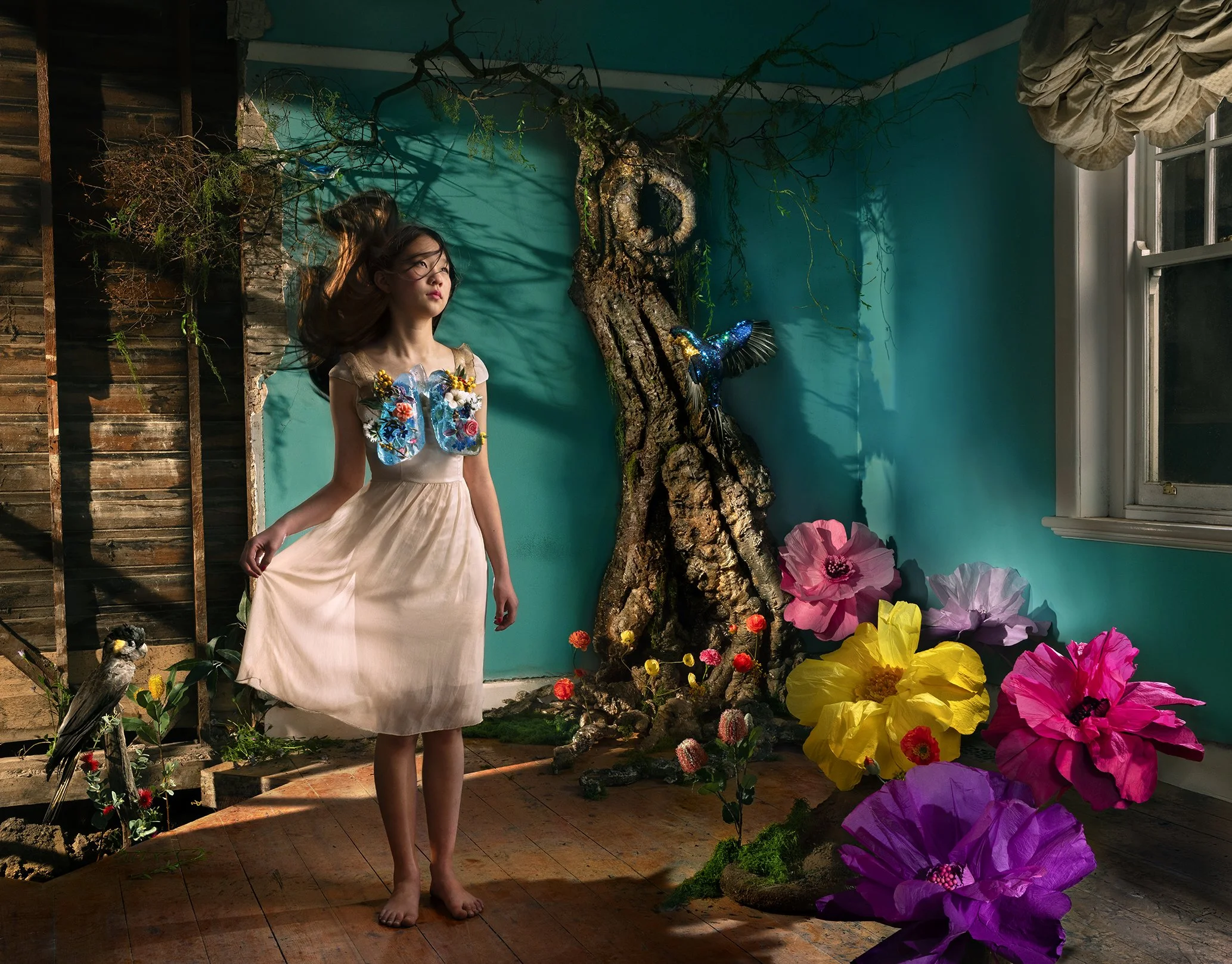
Field of Devotion, pigment ink on cotton rag, 93 x 118 cm
LDH: The final image in the series, Field of Devotion, feels quieter and more hopeful. Did you always know this series would end here?
Ultimately, I believe we will learn to revere the world again. That we will recognise that we are part of something much larger than ourselves, and that caring for the planet has to become a collective act rather than an individual one. I believe we will come together, put the world first, and find our way back to a sense of wonder and responsibility towards the place we call home.
So the girl standing in that field isn’t just an ending. She represents a possibility — a future I still believe in.
Thirteen by Samantha Everton will be exhibited at Arthouse Gallery, Sydney, from 17 September – 10 October 2026.