
Michaela Gleave Reaches Across Continua at Artspace
Interview by Lameah Nayeem
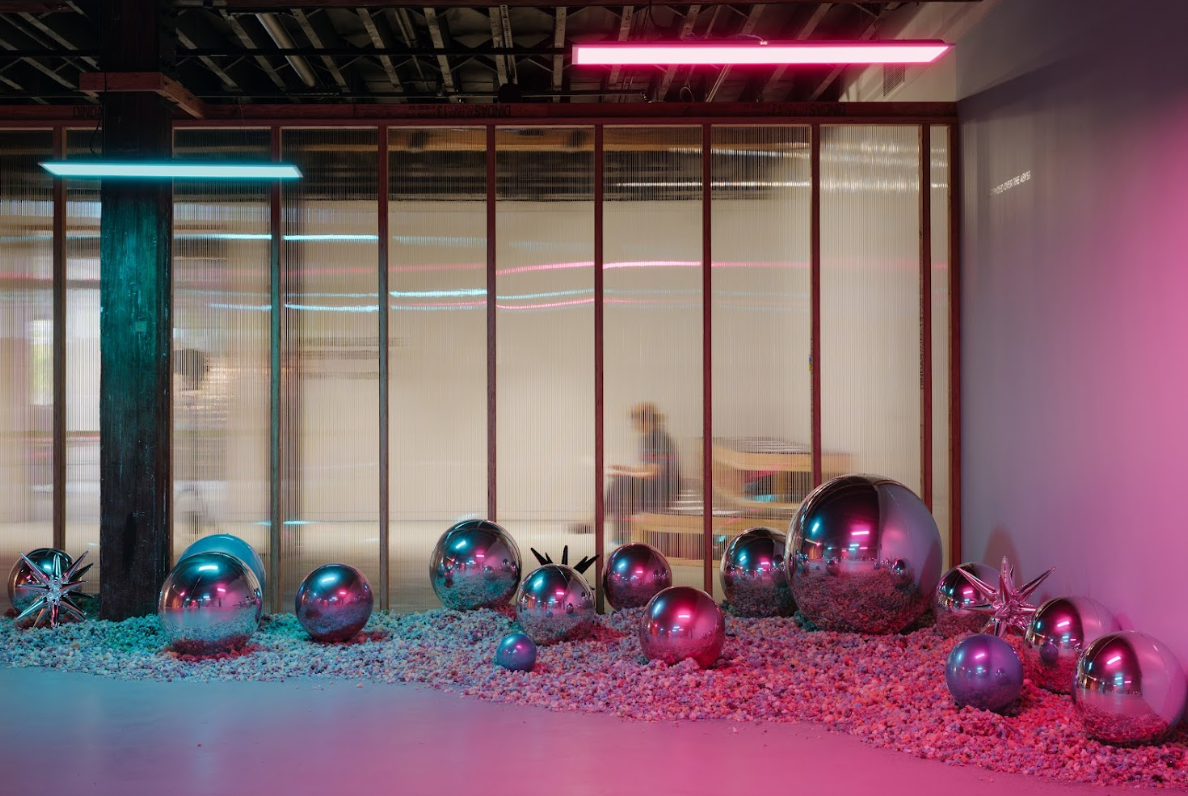
Michaela Gleave, ‘Event Horizon’, 2026. Installation view, Artspace, Sydney, 2026. Photo: © Hamish McIntosh.
How is meaning created on the precipice of mystery? How do we materialise time? Questions like these have long lingered on Michaela Gleave’s mind, and have recently shaped her latest exhibition, Event Horizon, at Artspace. Divided across multiple rooms, Gleave invites us to consider how the celestial, metaphysical, and spatial collide through form. Her practice runs across the verticals of philosophy, science, and research, often posing questions that have no simple answers, reaching towards new trajectories — both incorporeal and solid. It orbits the systematics of knowledge and the manners in which it is gained through the mind and body. With a virtue for perspectival manipulation, Event Horizon epitomises Gleave’s commitment to making tangible the invisible forces that govern our reality.
Below, she speaks with Lameah Nayeem about methods for understanding the madness of the universe, the challenges of working with abstract subject matter, and the line between scientist and artist.
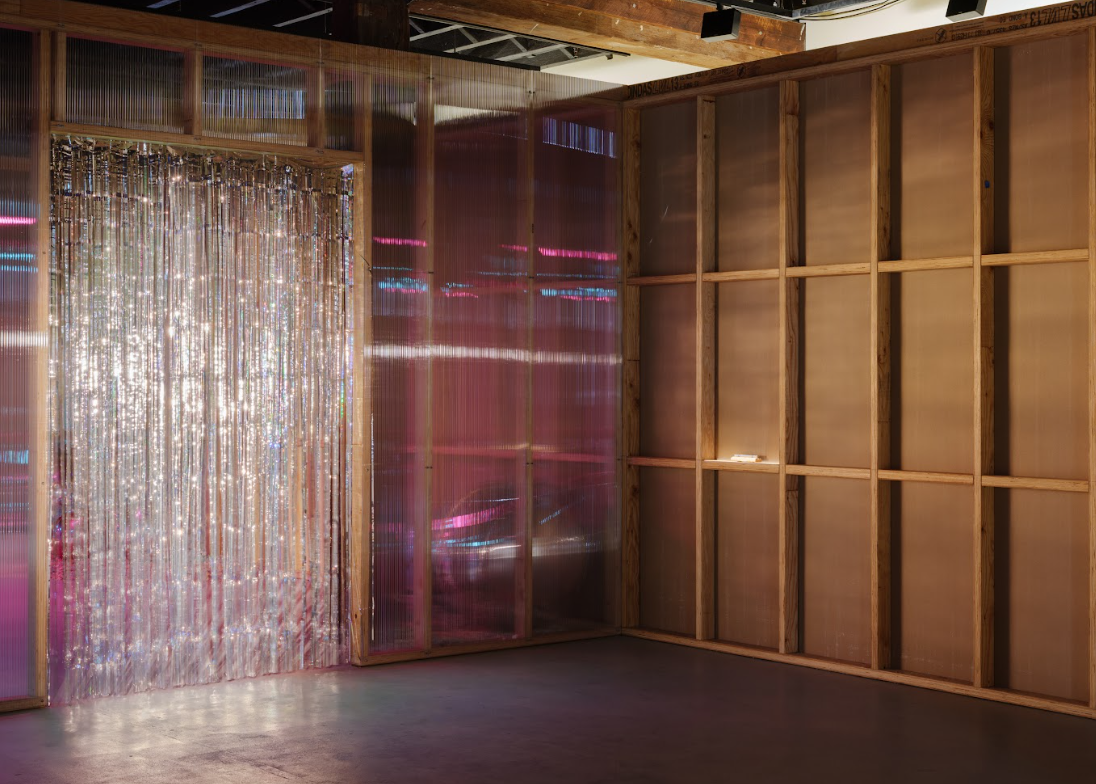
Michaela Gleave, ‘Event Horizon’, 2026. Installation view, Artspace, Sydney, 2026. Photo: © Hamish McIntosh.
LAMEAH NAYEEM: What first sparked the idea for Event Horizon?
MICHAELA GLEAVE: The exhibition builds on an ongoing interest in how knowledge is formed at the edges of observation. An event horizon in physics marks the boundary around a black hole beyond which information cannot return to an observer. It is not a physical surface, but a limit created by the structure of spacetime itself. I was drawn to this idea as a metaphor for the limits of knowledge more broadly.
Across science, philosophy and art there are many moments where our existing frameworks break down. Measurement becomes uncertain, language becomes inadequate, and we begin relying on inference, imagination or new forms of sensing. That threshold between what can be known and what remains unknowable became a starting point for the exhibition.
The project crystallised following a residency at CERN last February, which prompted a sense of coming full circle within my practice. It revisits a range of themes, materials and forms that have appeared throughout my work over the years, bringing together a number of projects and influences within a single, large-scale installation.
Rather than presenting individual works, the exhibition unfolds as a sequence of environments that explore perception itself: how we sense, interpret and construct meaning from the world around us.
LN: As you’ve mention, Event Horizon unfolds across multiple rooms, each markedly different from the next. How do you approach planning and constructing an exhibition in this kind of format?
MG: I tend to think of exhibitions as spatial compositions rather than collections of individual works. Each room becomes a kind of movement within a larger structure, with its own atmosphere, rhythm and conceptual focus.
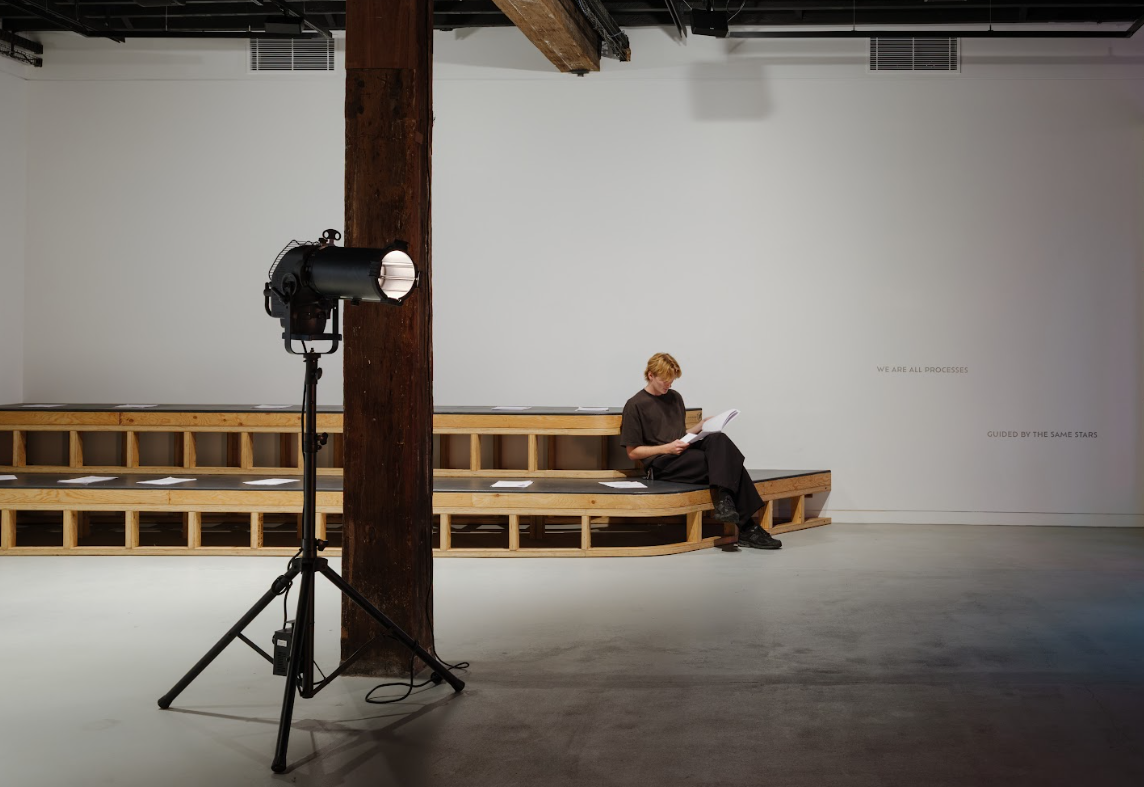
In Event Horizon, the exhibition is structured almost like a sonata, moving through a kind of exposition, development and recapitulation. The Reading Room provides an initial entry point into the ideas behind the exhibition. From there the other spaces move progressively toward more experiential forms of understanding through sound, vibration, light, atmosphere and geological matter.
Sound operates as a compositional thread across the exhibition, with tones, resonances and rhythms carrying between spaces. Physical materials and conceptual ideas also bleed across rooms, creating connections that unfold as visitors move through the galleries.
When planning the exhibition I think carefully about pacing and transitions between spaces. Moving through the show is intended to feel a little like moving through different states of perception. The spaces are contemplative, but also immersive and unstable. The overall structure allows audiences to encounter the ideas in multiple ways rather than through a single fixed narrative.
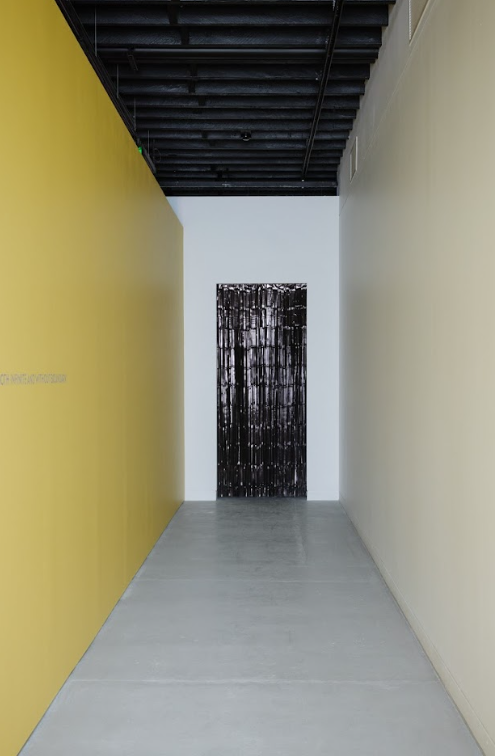
LN: There seems to be a tension in this exhibition between your thematic concerns — where even disciplines like mathematics and astrophysics become abstract — and the exhibition’s visual presentation. How do you approach form when the subject matter you’re working with is so vast?
MG: That tension is something I’m very interested in. Many of the phenomena I draw on, such as black holes, quantum fields and deep geological time, exist at scales that are fundamentally beyond human perception. We can only approach them indirectly through models, instruments or abstraction. Rather than trying to represent those phenomena literally, I focus on creating situations that mirror the conditions that surround them.
This exhibition also developed in a slightly more intuitive way than some of my previous projects, and the material language draws heavily on earlier works in my practice. Many of the materials are porous or transitory in some way, connecting back to my early interest in changing states of matter. Materials like foam, glitter, reflection, transparency and light itself appear alongside elements that treat air density and atmosphere as sculptural forms.
In that sense, the work isn’t illustrating scientific ideas. It’s more about translating some of the epistemological questions that emerge from those fields into spatial and sensory experiences.
LN: The inclusion of the Reading Room struck me as particularly distinctive. Where do you draw the line between guiding an audience and being overly prescriptive? Should artists take a back seat when it comes to how their work is interpreted, or do thematically driven exhibitions like Event Horizon complicate that idea?
MG: The Reading Room is intended as an invitation rather than a set of instructions. The exhibition draws on ideas from physics, cosmology, geology and philosophy, and the texts acknowledge some of those wider conversations without attempting to explain the work itself.
The selection is deliberately diverse. Rather than directing interpretation, the texts offer small entry points — almost like wormholes — into a much larger field of ideas.
At the same time, engaging with the readings isn’t necessary in order to experience the exhibition. Someone could move through the spaces purely on a sensory level and have a perfectly valid encounter with the work.
I’ve never been interested in making didactic exhibitions. For me, the texts expand the field of possibility rather than narrowing it. They sit alongside the work as another layer that visitors can engage with if they wish, opening up connections rather than prescribing meaning.
LN: In Event Horizon, you employ a range of techniques to manipulate light and perception. Are there any approaches you find especially effective in shaping the audience’s emotional or sensory experience?
MG: I pay close attention to things that are often invisible within a space. Air movement, temperature, the pacing of footsteps, the scale of objects, and moments of contraction and expansion all play a role in shaping how a space is experienced.
Light and sound are important tools within that. Changes in light level, sound frequency or atmospheric conditions can alter how people move through a space and how aware they become of their own bodies. The twinkling of light or the slow movement of air can shift the energy of a room quite significantly.
I’m particularly interested in thresholds where perception becomes slightly unstable. Very low frequency sound or light patterns can heighten people’s sensitivity to the environment without them necessarily identifying a single cause.
Those moments can encourage audiences to slow down and attune more closely to the space. Rather than directing a specific emotional response, the aim is to open up a field of perception where people begin noticing things they might otherwise overlook.
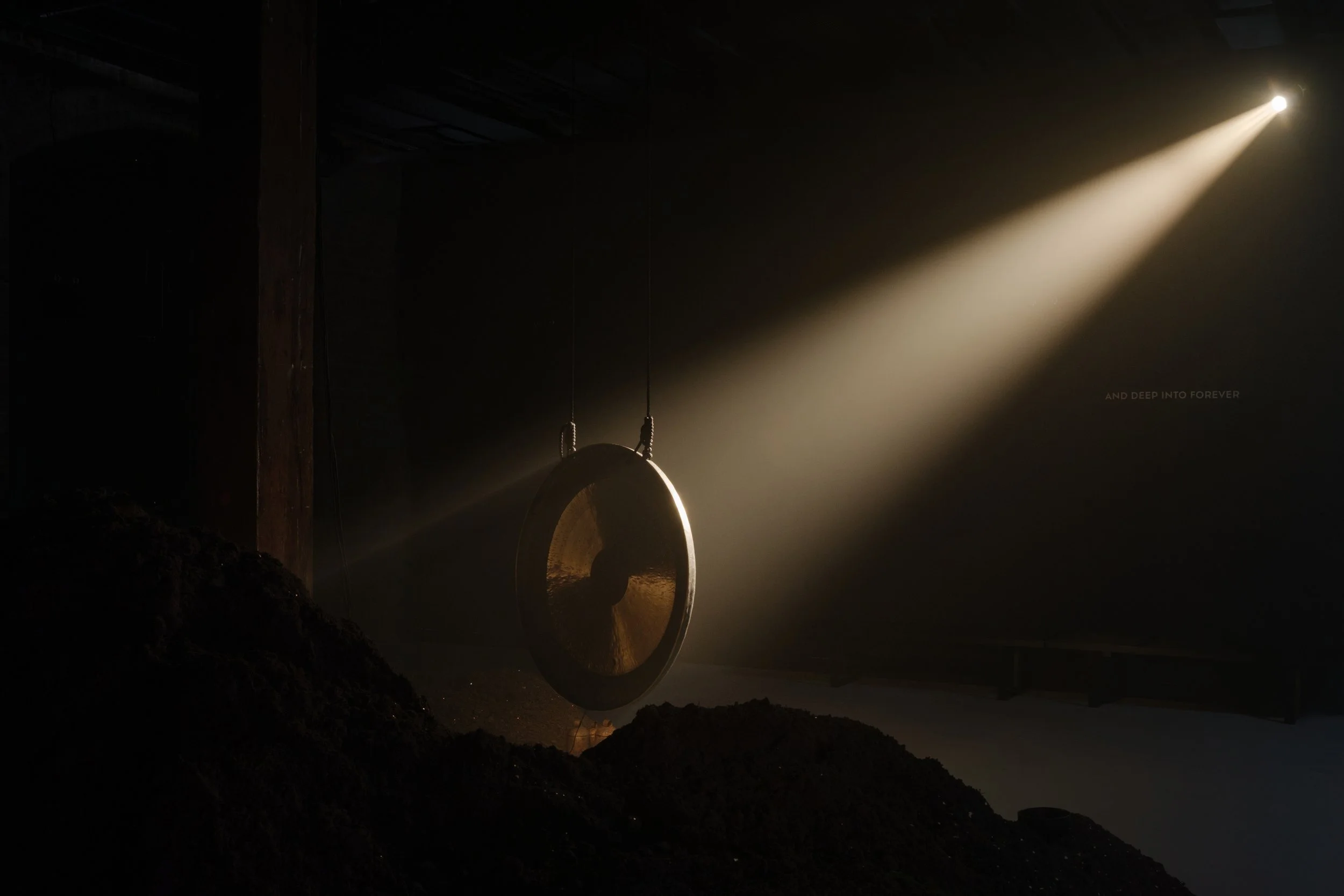
Michaela Gleave, ‘Event Horizon’, 2026. Installation view, Artspace, Sydney, 2026. Photo: © Hamish McIntosh.
LN: How did you navigate the exhibition space itself when developing Event Horizon? Were there moments where the work felt in tension with the architecture or constraints of the space?
Context is very important to me when developing an exhibition. At Artspace, the pillars in the heritage building are the most distinctive and undeniable feature of the galleries, and they played a significant role in shaping the exhibition.
Rather than trying to minimise or hide them, I chose to embrace the pillars and work with them as structural elements within the space. They help organise the movement of the exhibition and influence how different zones unfold within the galleries.
Some works respond quite directly to the architecture, while others transform the spatial experience more broadly. For example, the mound in the Organic Realm introduces geological material into the gallery, creating a very different relationship between the body and the floor of the space.
Constraints are often productive in that sense. The architecture becomes part of the conversation between the work, the space and the audience moving through it.
LN: Your career includes numerous awards, prizes, and an artist-in-residence position at CSIRO Astronomy and Space Science. Do you ever feel like a scientist with the sensibility of an artist, or is there little distinction between those roles in your practice?
MG: I don’t see my work as occupying the role of a scientist, but I do share a curiosity about how the universe works. Scientific research and artistic practice both involve asking questions about the world, although they approach finding answers to those questions in very different ways.
Science is oriented toward measurement, evidence and testable explanations. Art allows space for speculation, metaphor and experiential forms of knowledge.
What interests me most is the territory where those modes of thinking meet. Many of the scientific ideas that inspire the work are themselves deeply imaginative — black holes, quantum entanglement, cosmic inflation. They push language and intuition to their limits.
Art provides another way of engaging with those ideas, one that is less about explaining them and more about creating experiences that resonate with the sense of wonder they provoke. I often think of science as working at the edge of the sea of the unknown, while art tries to throw you right into it.