
Ming Wong’s Floating Opera: ‘Fata Morgana (I)’
Interview by Lameah Nayeem
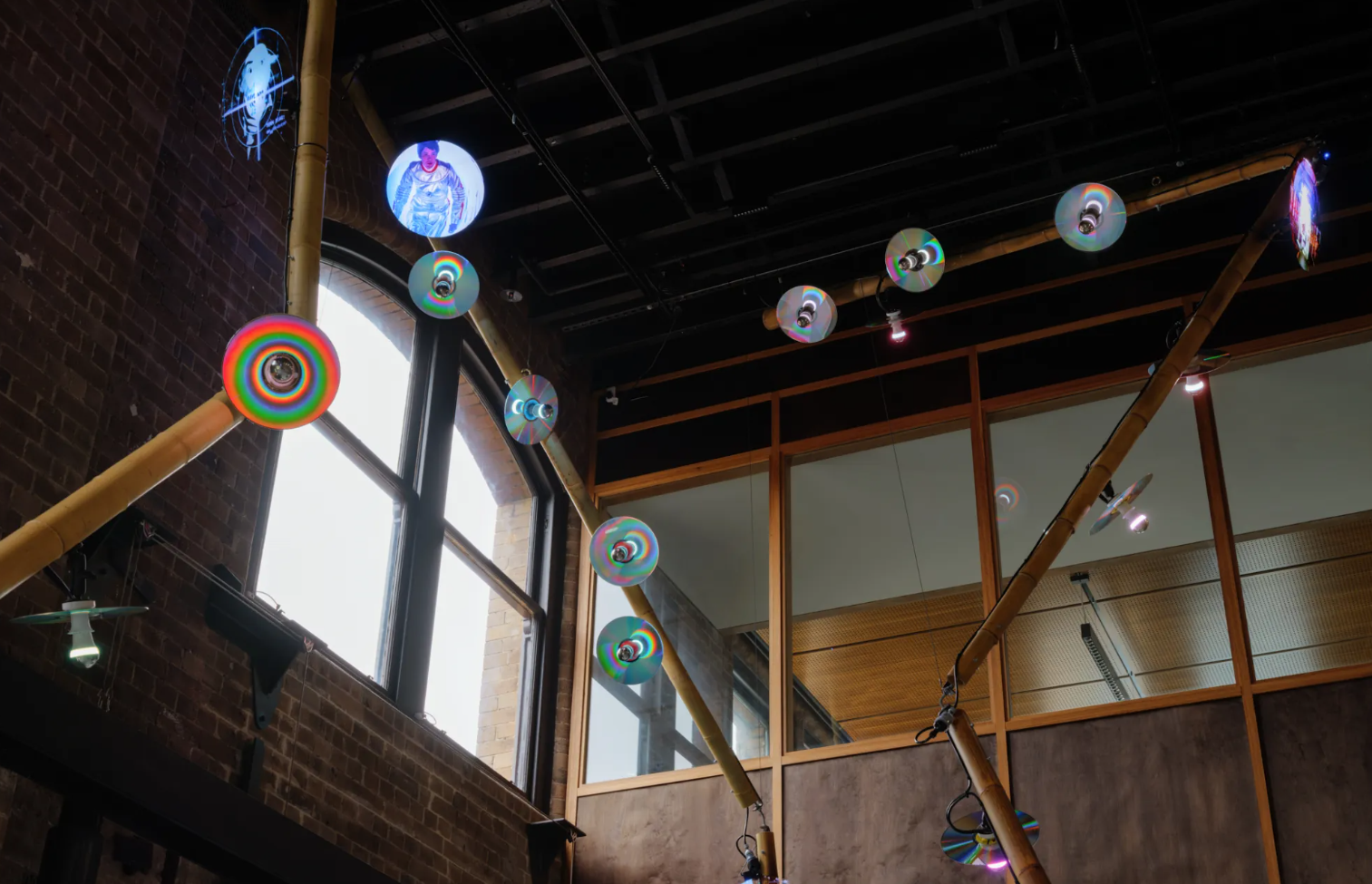
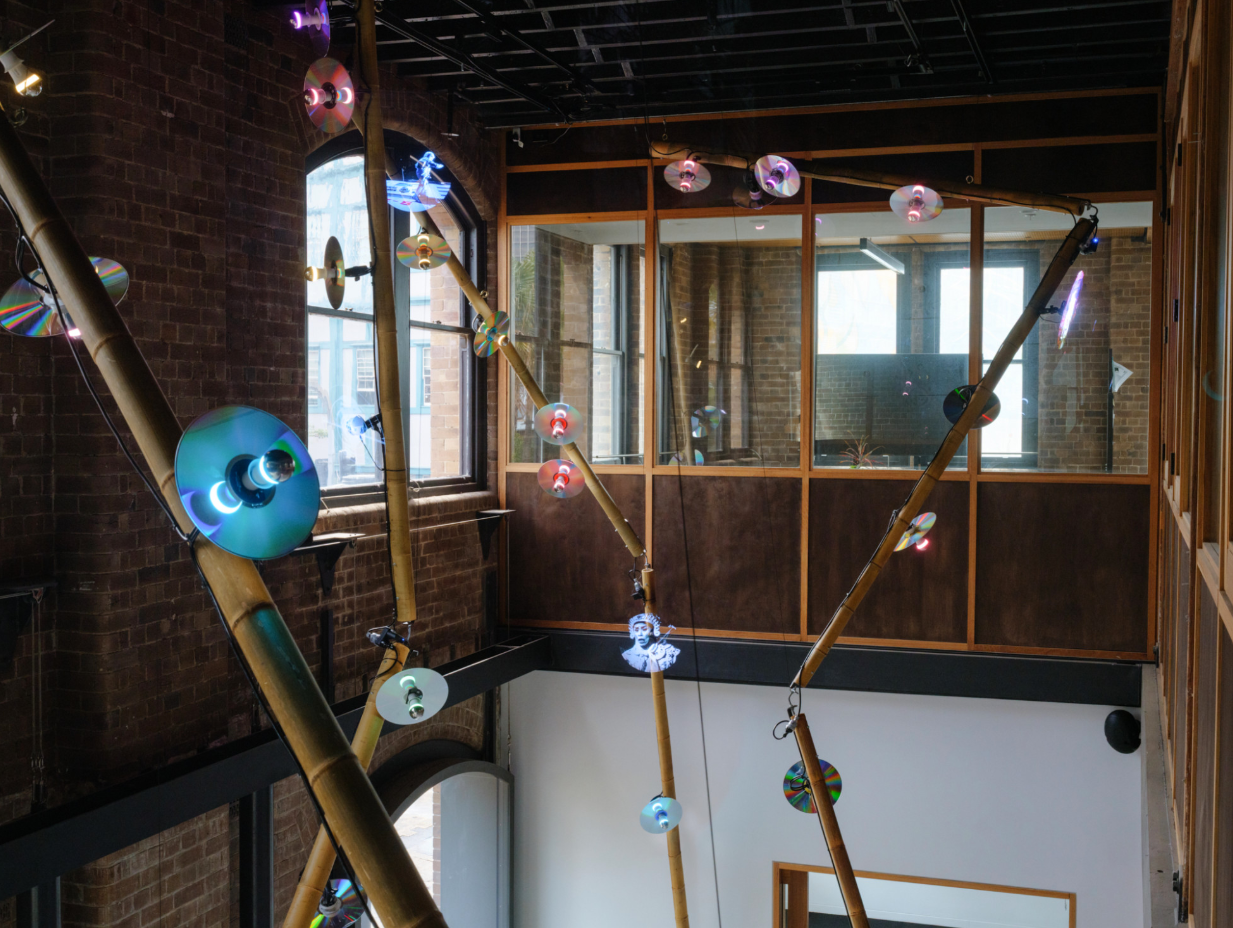
Ming Wong in collaboration with Liam Morgan, Fata Morgana (I), 2026. Installation view, Artspace, Sydney, 2026. All images © Hamish McIntosh
Identity descending, reconstituted, and sonorous. Ming Wong’s Fata Morgana (I) at Artspace draws on Chinese opera and pop music to explore cultural identity. Based in Berlin, Wong presents Fata Morgana (I) as an evolution of two prior projects: Vast Ocean, Endless Skies (2025) and Wayang Spaceship (2022).
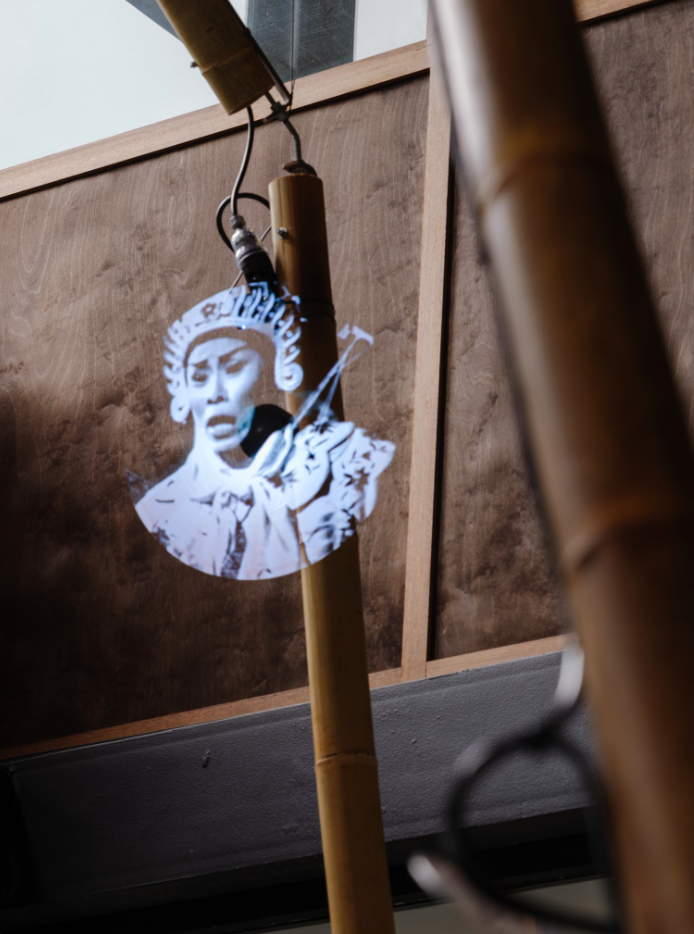
Drawing on a myriad of technologies and visual techniques to weave heritage Asian theatre with fabulist imaginations, Wong is an arch-aesthete, splicing sci-fi imagery with nostalgia. Beneath the neon glow of each spinning LaserDisc in the gallery’s Void Space lies a deep engagement with immigrant cultures and multiculturalism. With holographs referencing karaoke and Cantopop flitting in and out, Wong reimagines tenets of East Asian culture as an inverted world, floating in air and refracted by light. Central to all of his works, and certainly Fata Morgana (I), is the faculty of vision. As discrete categories of time, language, and place dissolve, Wong challenges the validity of recognisable images and constructions, offering an alternate mode of seeing.
Below, he speaks with Lameah Nayeem about his practice, the evolving ideas underpinning his work, and the paradox of moving forward whilst looking back.
LAMEAH NAYEEM: The title of your exhibition, Fata Morgana (I), refers to a complex type of mirage. What drew you to this phenomenon as the framing concept for the work?
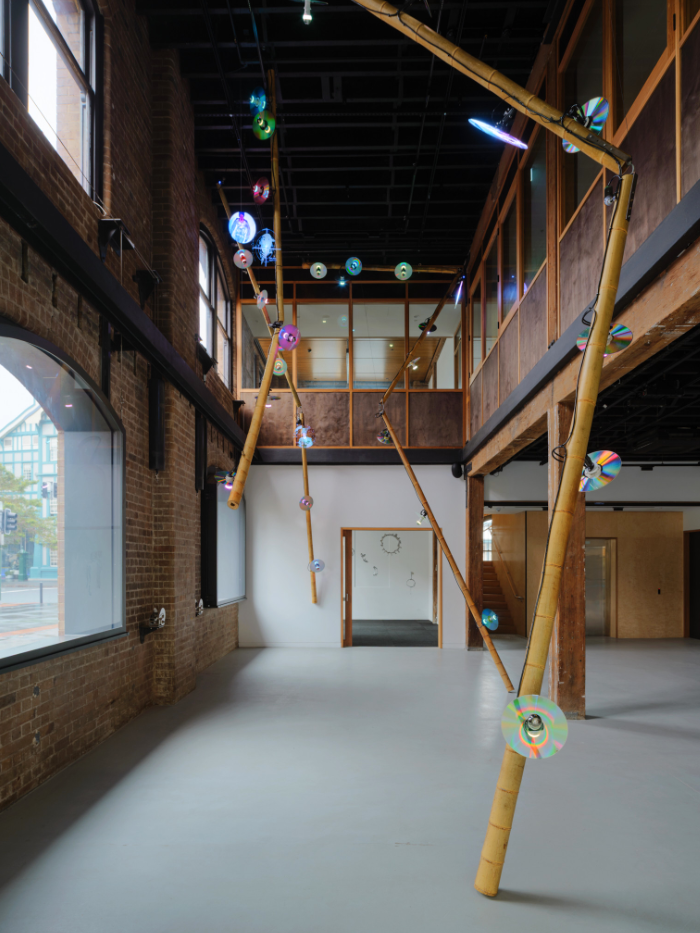
MING WONG: Fata Morgana (I) is a mirage of floating worlds, the mirroring of a landscape. The work is created as though lifted off the floor, descending from the ceiling, and working from both sides of the hemispheres. The work is viewable from above or below, inside or outside; and the colours are constantly shifting through a sequence, the surrounding changes accordingly, ever evolving.
LN: Your work often draws on characters from world cinema and opera. What makes these art forms such rich sources you can return to and still find something new to reinterpret?
MW: In our memories, characters collide from different times and spaces. Because I hold so many characters from very distinct cultural sources and formal frameworks, the encounters and collisions of worlds are unexpected, and keep growing more complex as one accumulates experiences and ideas over time. The imagination allows these things that normally do not belong together, to come together, and there is much unexpected energy that comes from such contact.
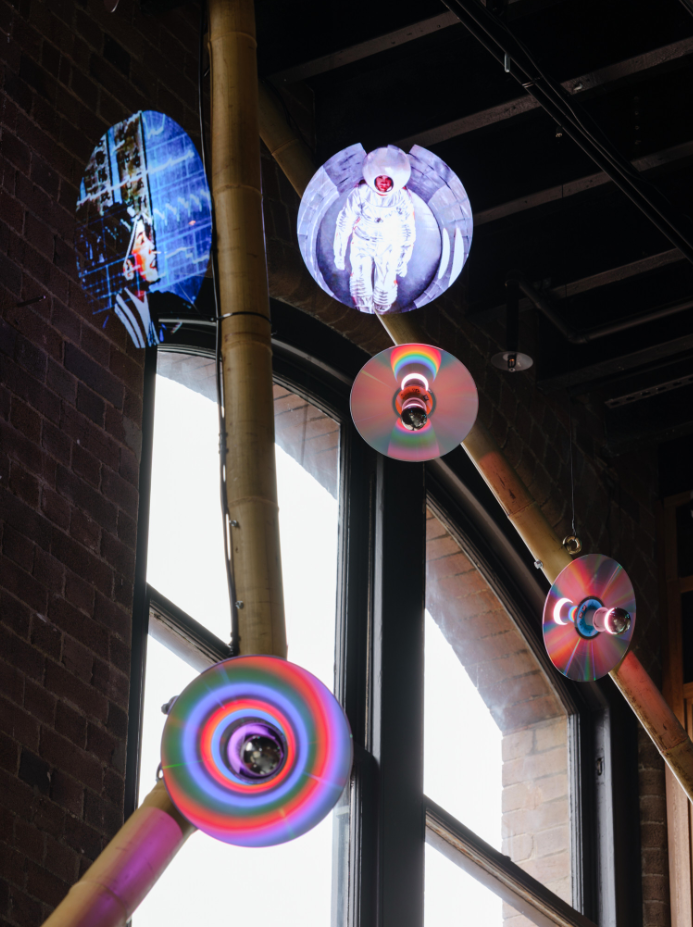
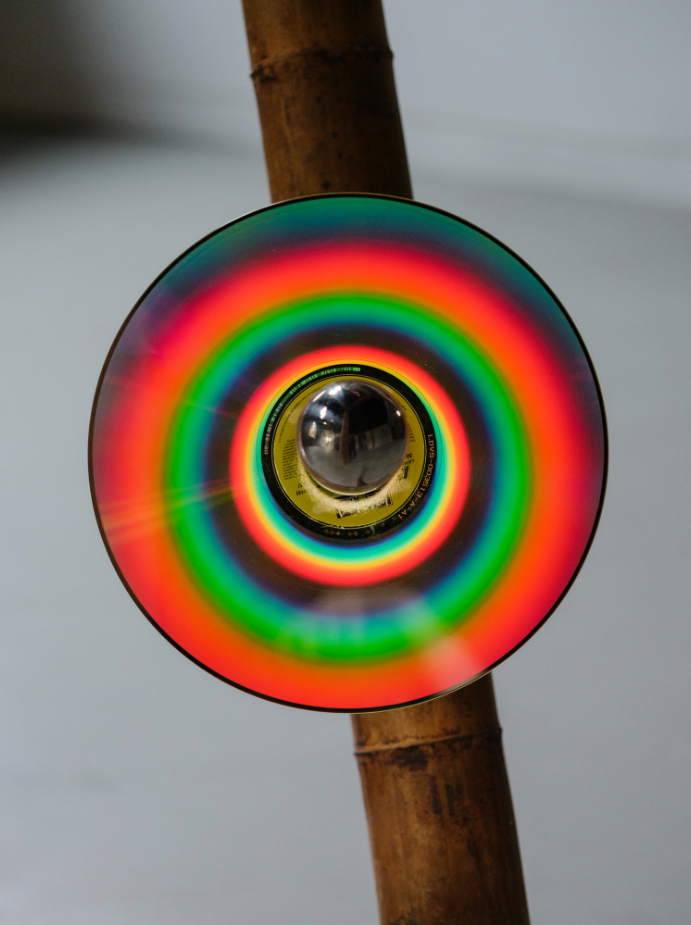
LN: Fata Morgana (I) is constructed from vertical bamboo culms, 1990s mirrored LaserDiscs and 3D fan holograms. How does the combination of nostalgic and contemporary technologies shape the narrative of this installation?
MW: On one level, I was thinking of traditional Chinese brush paintings of cherry blossoms, upside down, the lengths of bamboo like branches, and the discus as blossoms facing different directions. It could also recall the trajectories of metallic debris falling in space. It’s the defunct technologies of the LaserDiscs, filled with ideas about the future (scifi from the 90s), where you catch sight of space explorers and classical scholar warrior figures intermingling.
LN: You've stated that your work 'proposes an alternative to Western cultural models'. Can you expand on the importance of diasporic media and how Fata Morgana (I) brings that into focus?
MW: The ideas, forms, and media vacillate between parallel histories of art, culture, philosophy from seemingly distant and incompatible cultural sources, and new possible 'third spaces' can emerge to point out possibilities out of fixed ways of thinking, doing and dreaming. As described earlier, the imaginative mind can travel in several directions at once, it doesn't have to be a linear or binary framework. A 'diasporic' way goes outwards in multiple dimensions.
LN: Fata Morgana (I) is an evolution of your earlier projects Wayang Spaceship (2022) and Vast Ocean, Endless Skies (2025). What ideas have grown, mutated or been discarded over those four years?
MW:Wayang Spaceship was a tribute to the traditional travelling Chinese opera stage, originally over the sea, from Southern China to South East Asia and beyond. From today's perspective it opens up ways of thinking around time and space travel. Vast Oceans, Endless Skies, acknowledges a development from the outdoor stage to an urban performance practice of karaoke using LaserDiscs. It examines the evolution of Cantopop and Mandopop where traditional musical forms mutate with the contact of Western Pop music, again via nodes such as Hong Kong connecting to other nodes such as Singapore, Taiwan, Vancouver, Australia. Fata Morgana (I) combines materials from both works — natural wood, LaserDiscs — but the palette of colored light persists throughout, the root source of cinema and performance histories remains; as though the fused entity of forms and ideas from one work shape-shifts and travels across space.
LN: Fata Morgana (I) nudges audiences to reconsider the act of seeing and hearing. What kinds of realisations or experiences are you hoping visitors might come away with?
MW: Simple, humble materials, castoffs, cutoffs, memories, data, reflections... we can each bring our subjectivities to looking at the things that surround us in the everyday.
LN: Your work is often described as “retrofuturist”. Do you find that label useful, or does it fall short of capturing the way your work moves across time, genre, and culture?
MW: It could be overloaded, if one attaches too much scientific significance. Literally it alludes to going backwards in order to know how to move forwards. I think that capacity is what makes us human — or inhuman without that capacity to learn from the past. Everything around us has histories and it's humble to think about it and take our ego out of the story. The further back your mind reaches the more you can read into possible futures.