
Tony Albert on Using Art as a Conduit for First Nation Voices
Interview by Lameah Nayeem
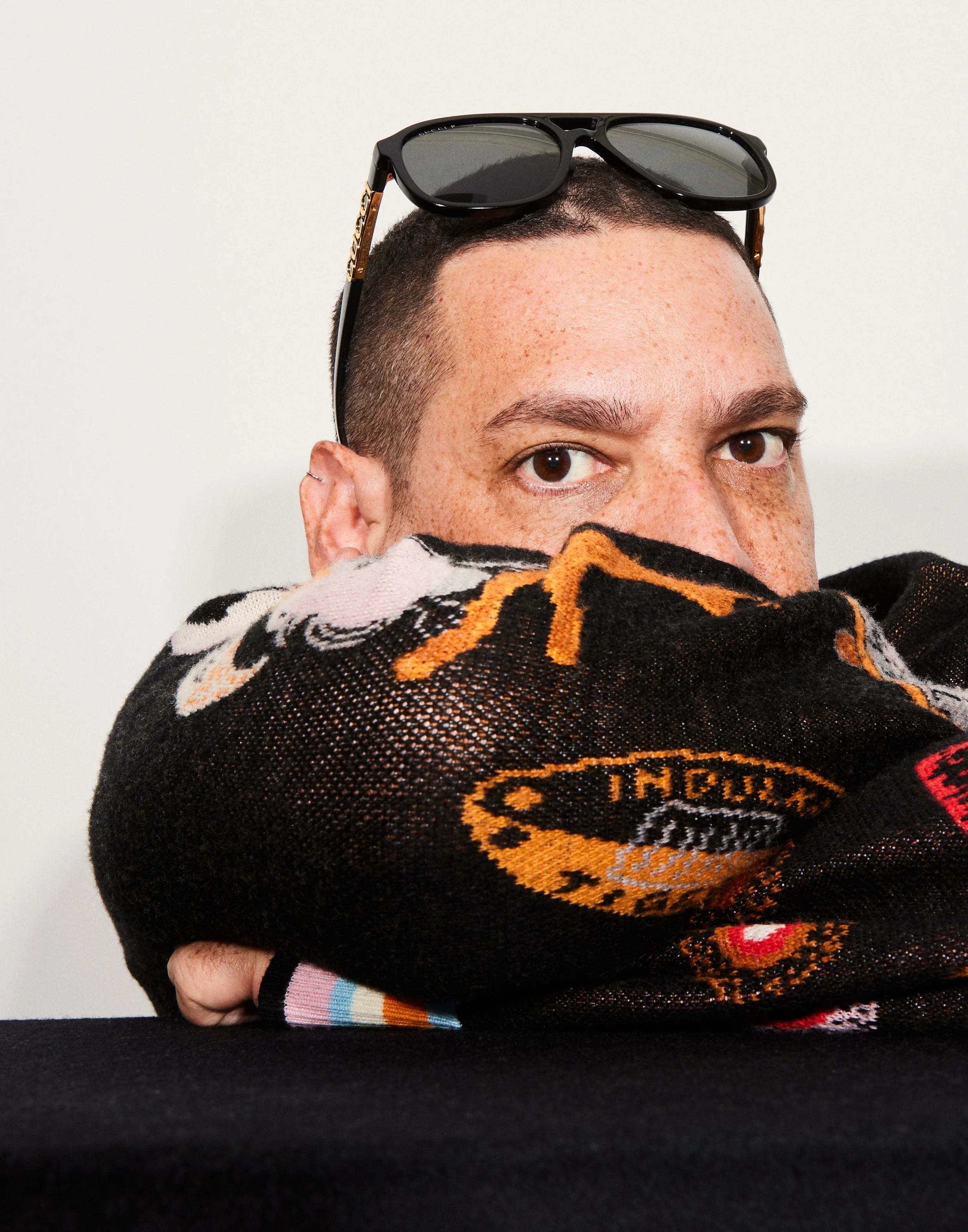
Photograph: Manolo Campion
A stroll through Circular Quay is a carnival for the senses. From the bleating of ferries, to the mellow bitter of overpriced coffee, the most prevalent may be the numerous window displays saturated with souvenirs. Aboriginal artworks, boomerangs and didgeridoos have become shorthand for national identity, all allegedly authentic as signified by a dark-green "Australian-made" tag.
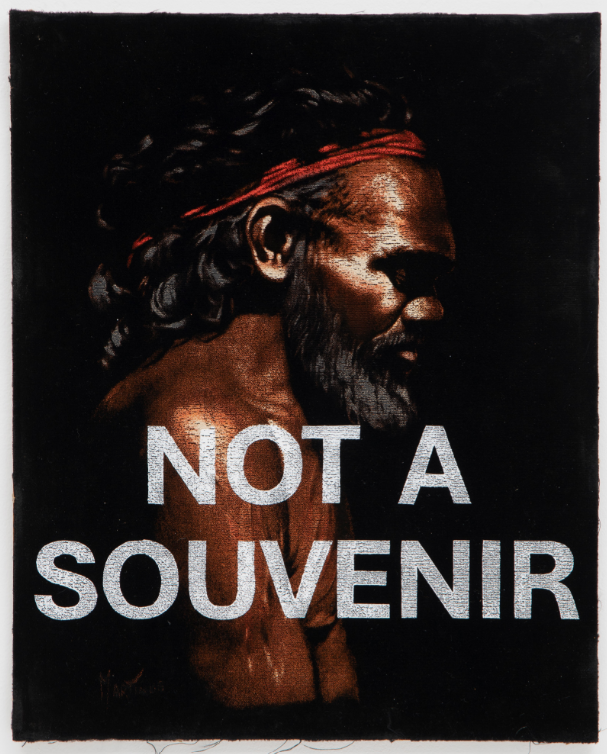
Here, Indigenous Australian artist Tony Albert interjects. Inspired by the Museum of Contemporary Art's location, nestled on the Sydney Harbour at Tallawoladah, Albert corrects and criticises the misappropriation of Aboriginal identity seen in the pursuit of tourism and souvenir culture in Not a Souvenir. Taking over the Museum of Contemporary Art from 21 May, the exhibition is a reclamation of sovereignty over objects that have long been reduced to commerce and caricature. Through assemblage, installation, and found materials, Albert reframes what has been commodified, returning agency and narrative to forms that have been stripped of both. Ahead of the exhibition's opening, he speaks with Lameah Nayeem over a call.
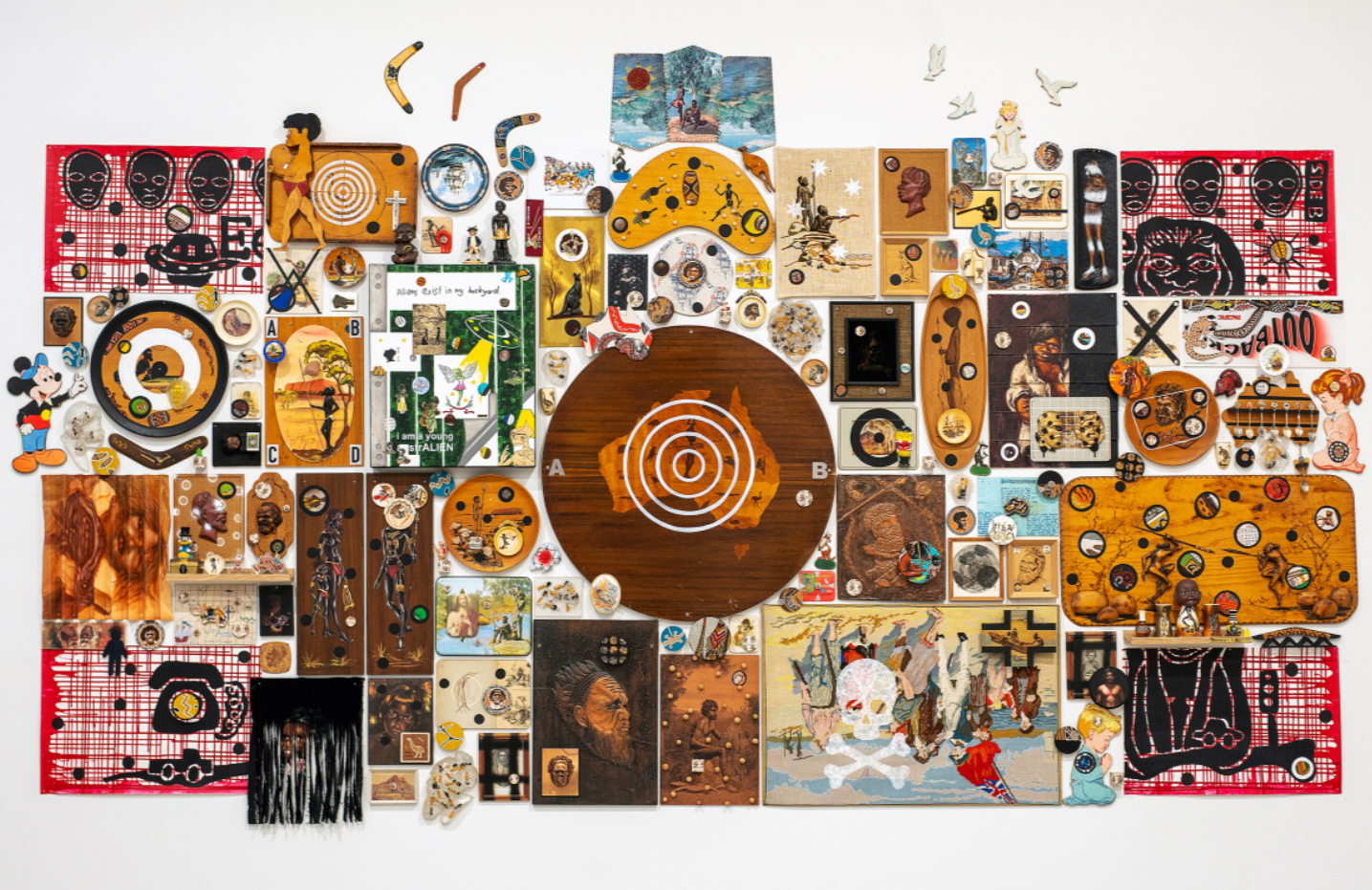
Tony Albert, ‘Story, Place’, 2023, Tia Collection © Tony Albert, image courtesy the artist, Tia Collection and Sullivan + Strumpf, photograph: Rhett Hammerton
LAMEAH NAYEEM: Your exhibition Not a Souvenir engages directly with the commodification of Aboriginal culture. How do you approach transforming objects or symbols that have been reduced to souvenirs?
TONY ALBERT: I guess for me it’s because so much of my practice is built on these objects that I’ve collected over a long period of time. I don’t usually respond to space and place in the way I have here. But the opportunity to show at the Museum of Contemporary Art, an epicenter of souvenir culture where these goods are being sold, felt like the right moment to push further into the space and place in which I’m showing. These objects I use are often reduced to having no voice or autonomy in their own right. It has always been within my artistic practice to give a voice to these objects and release them with their own sense of agency. So they all played hand in hand in shaping what Not a Souvenir is about.
LN: The title of the exhibition reads as a rejection of a particular idea. What do you want to put forward in its place?
TA: The objects, in a way, have a metaphorical attachment to us as people. We’ve been silenced as well, or there are moments when we’re spoken for, or meant to be seen and not heard. This is an opportunity to derail that context and speak from us, for us. That’s what the arc, for me, has always done. It’s an opportunity not just to raise awareness, but to have these important conversations through these objects.
LN: You also work in sculpture, photography, and installation. When dealing with material that is so politically and historically loaded, what informs your decision about the form the work should take?
TA: I find, as a conceptually driven artist, that I straddle the idea of the work alongside its medium and development. For me, it’s about meshing those things together. Sometimes the objects themselves are the best medium; other times the work translates into photography, video, or sculpture, or all of the above. I often try everything to determine which execution works best visually.
That also means taking an idea and sometimes exhausting it, or pushing it past where it needs to go, in order to understand where it should sit. In Not a Souvenir, you see where everything has settled. What I mean is that, within the studio, I’ll take something and work it, rework it, and push it until the physical outcome no longer reflects what I’m trying to say. That’s when I know I’ve gone too far. But having that full spectrum allows me to look across it and determine where the work is most successful.
The exhibition represents a span of media used in my practice, showing why photography is most effective at one moment, and why installation or sculpture becomes more important at another. It creates an engagement across these forms. What the exhibition offers is a cross-section of mediums that demonstrates how a single conceptual framework can be expressed differently, and why each approach succeeds within different bodies of work.
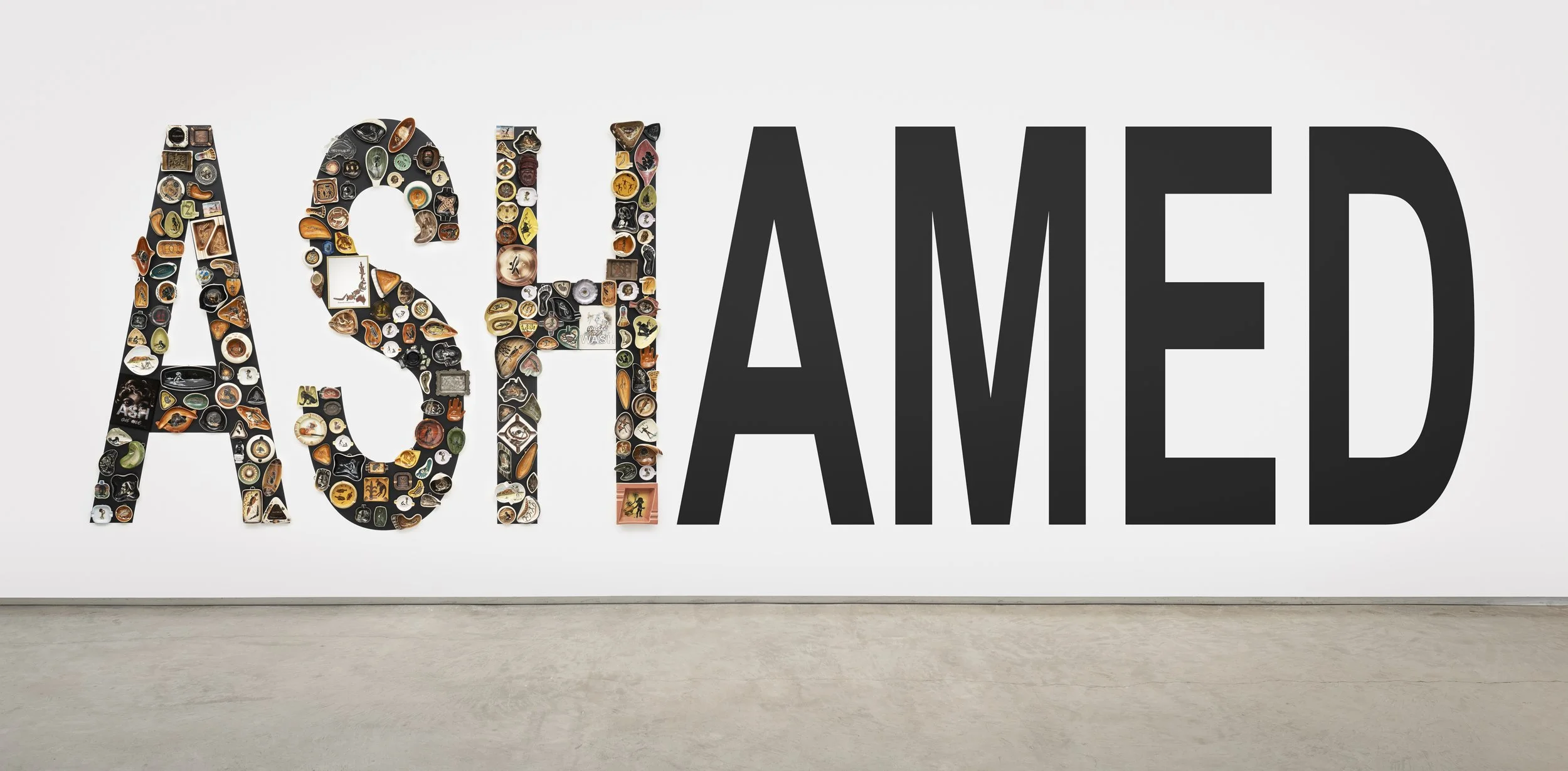
Tony Albert, ‘Ashamed’, 2025, acrylic and found vintage objects applied to vinyl, courtesy of the artist and Sullivan+Strumpf, photo: Mark Pokorny
LN: How do you approach reclaiming authorship over these found objects and over a culture that has been commodified to the point of caricature?
TA: I think using art as the conduit for that voice is central. Collaboration plays a huge role in my practice. Even though the framework of the exhibition is mine, you’ll find many other artists intertwined within the works in different ways. The Optimism series includes my cousin, Erica Marita, and her Jarin bags, which are photographed with members of the local Sydney Indigenous community who participated in that workshop. So there are iterations throughout the work.
At the heart of it, it’s very much reflective of a communal or joint voice. I don’t think my intervention is the only one that should take place. I’ve sat with and reconciled this collection over a long period of time, so there’s a sense of comfort and willingness to draw out these voices within the objects.
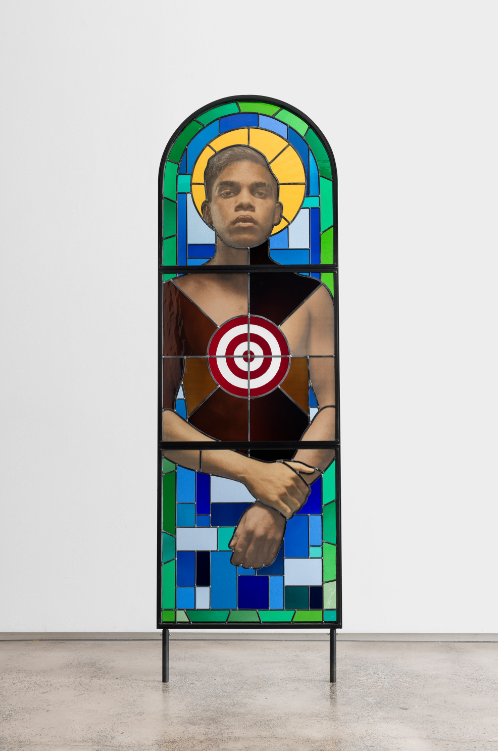
The work spans from the intensely political to pieces that are humorous or playful. It’s about finding the right approach for each object, uncovering something different in each case. In this exhibition, I was also fortunate to undertake a residency at Glassworks, exploring what it means to transform these objects into glass, the invisibility and fragility that come with that. This feeds into how the objects speak, ranging from delicate expressions to works that feel strong, even aggressive, in their own right.
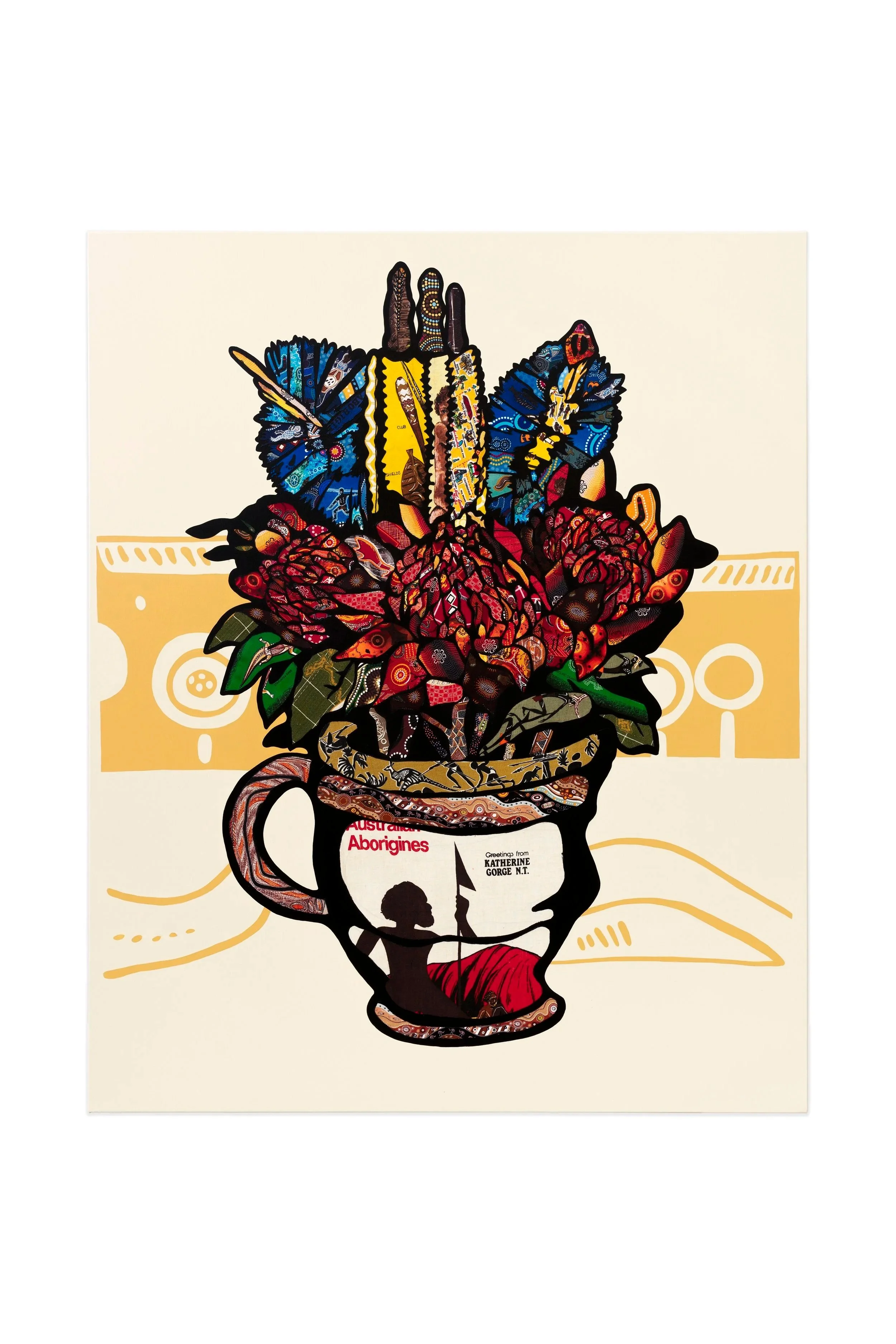

LN: You’ve mentioned how important location was for you. Walking around the harbour, you’ll see shop fronts loaded with Australian souvenirs. Turning to the museum space itself, how do you engage with the limitations of the MCA as an institutional setting?
TA: These institutions are another boundary, or an extension of that, historically. But when you look at more recent adaptations and audiences, they’re opening up to different ways of decolonising or indigenising space and place. I think this show is a testament to that. It sits within an “international” space, and even that terminology is interesting. Why wouldn’t an Aboriginal context sit within the framework of the international, or vice versa? It’s about playing with those ideas rather than simply accepting them as they are meant to be used.
The more artists intervene within that framework, the more interesting these conversations become. The answer is to keep having these conversations, to keep mixing things up, and to keep challenging institutional ideas and frameworks. That’s why shows like this become so important.
LN: You also collaborated with curator Bruce Johnson McLean. How did that dialogue shape the exhibition?
TA: It’s wonderful to have a curator from outside the institution. That said, Rebecca Ray, the curator of Indigenous art at the MCA, is also overseeing the Aboriginal space. Within the context of the exhibition, this opens up an opportunity to show the collection as it is, without intervention, and to highlight the importance of these objects and the breadth of their existence.
Bruce and I met in the early 2000s, around 2001, and he has curated my work in the past. There’s a strong understanding of the work there, and I don’t think anyone else could provide as much context as he can, given his knowledge of me and my practice. What’s interesting about my practice is that, while the conceptual framework has remained centred, it has taken on many different manifestations over the years. He’s familiar with that evolution.
I’m really grateful to have someone like Bruce involved, who is one of the most seasoned experts on my work.
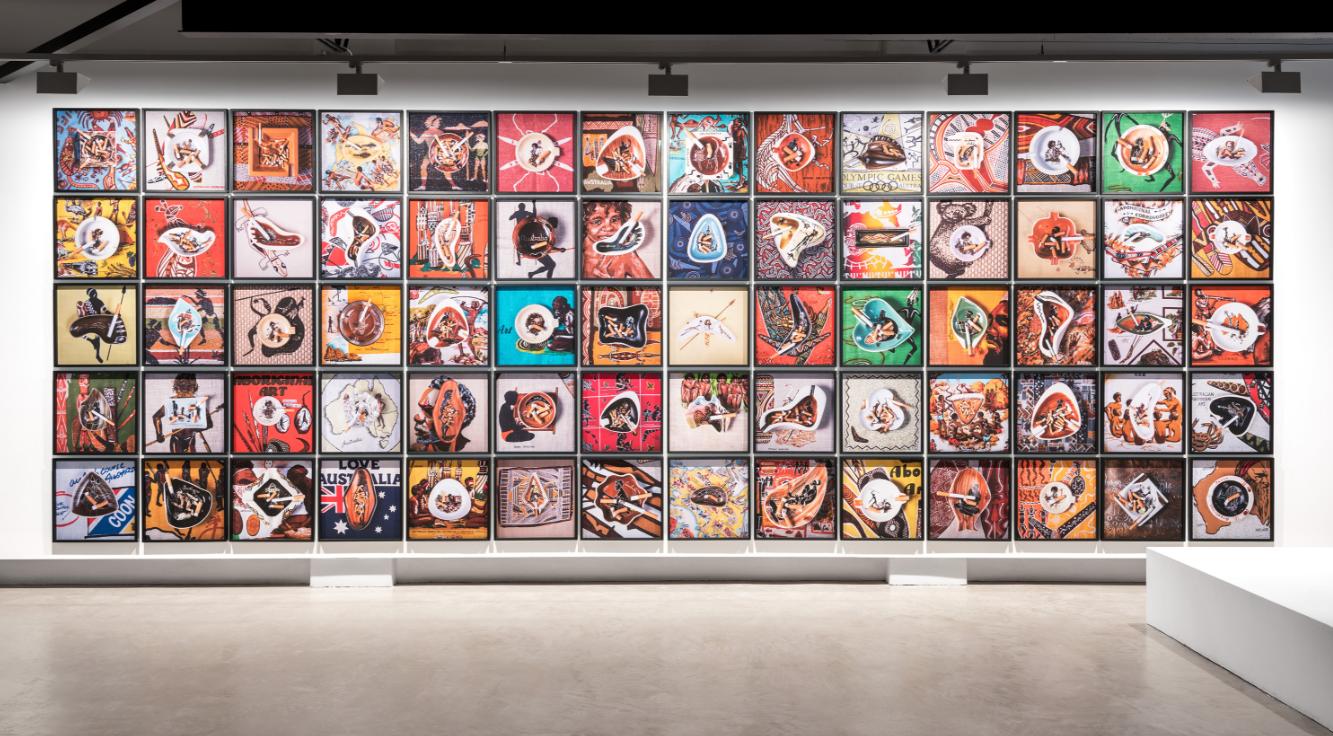
Tony Albert, ‘Mid Century Modern’, 2016, Collection, HOTA Gallery, gifted by the citizens of the Gold Coast to future generations, image courtesy of the artist and Sullivan+Strumpf, photograph: Mark Pokorny
LN: What kind of response or reflection do you hope the exhibition provokes in audiences encountering the exhibition?
TA: I hope it shows the scale of the commodification of appropriation, and that people don’t often realise how large this industry was. When you see the collection dispersed across an exhibition like this, you get a real sense of how many of these objects existed. They’re not really part of the framework of what we know, see, and understand now. These objects don’t hold much monetary value, but their cultural value is very strong.
They’re not typically collected by museums or institutions; they’re hidden away, swept under the rug, or deemed insignificant. By engaging with that, the work heightens the objectivity attached to them. I hope people understand the metaphor here, and the ways in which Indigenous people have been used and exploited without retribution, exchange, or a voice. What does it mean when people can’t speak for themselves, or are spoken for?
Within the work, giving these objects their own autonomy and voice allows for something powerful to emerge. That’s what we want as people. For our voices to be heard on our own terms. I want audiences to understand that we are here, we have our own voice, and we want that voice to be heard.