
A Twenty-Year Celebration with Mitch Cairns’ ‘Artist’s Mouth’
Interview by Maeve Sullivan
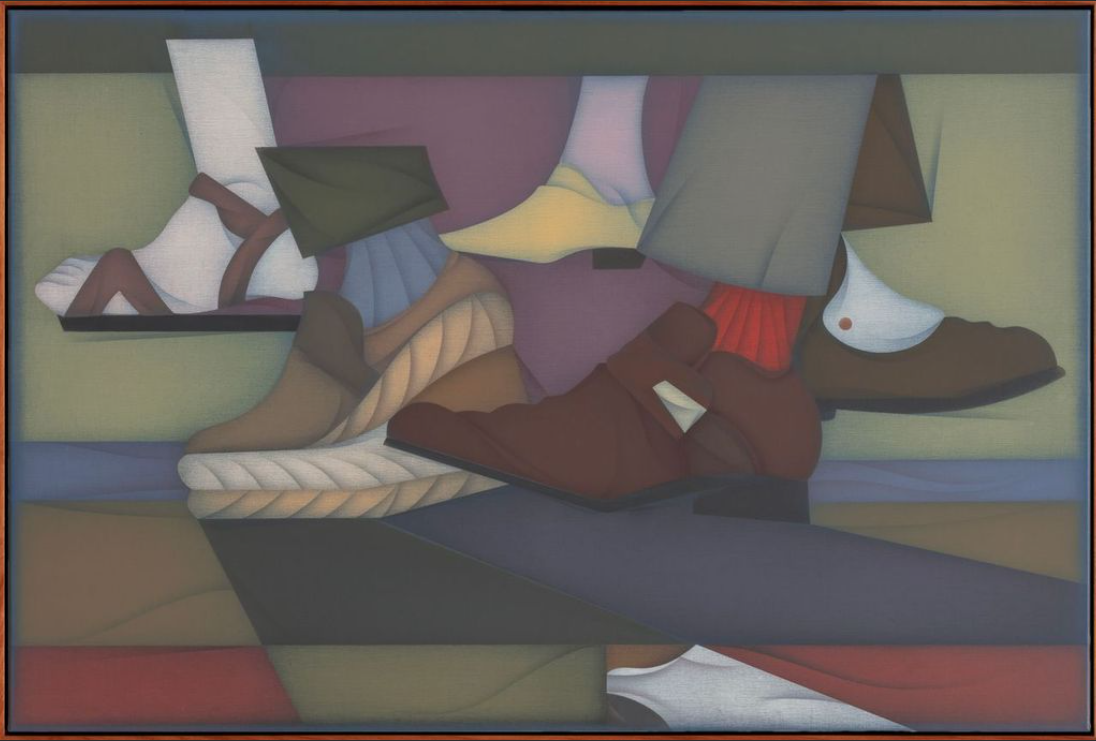
Mitch Cairns, Redpath Shoes or Cover Charge, 2025, oil on linen, Murdoch University Art Collection, image courtesy the artist and The Commercial, Sydney © the artist, photograph: The Commercial
Mitch Cairns resists the idea that his art should resolve into a neat, tidy narrative. Instead, his practice unfolds on its own terms, guided more by intuition than by long-term, commercial strategy. Mitch Cairns: Artist’s Mouth marks the culmination of two decades of Cairns’ artistic practice and will be the largest and most comprehensive presentation of his work to date. A joint project between the National Art School Gallery and Meanjin/Brisbane’s Institute of Modern Art (IMA), the major survey is curated by NAS Gallery Curator Lucy Latella and IMA Director Robert Leonard. It will be presented at the National Art School (NAS) Gallery from 1 May to 11 July 2026 and at IMA from 10 October to 20 December 2026.
Since graduating from the National Art School (NAS) in 2006, Cairns’ evolution can be traced across 48 artworks on display, largely drawn from institutional and private collections. These include works from his years of training and his 2017 Archibald Prize–winning portrait of his partner and fellow artist, Agatha Gothe-Snape. Most impressive within this selection is the distinct style and visual language Cairns has sustained—colourful scenes flattened into planes, evoking modernist and Cubist influence that disrupt traditional realism. Maeve Sullivan spoke with Mitch by phone, and discussed his homecoming to the National Art School and how its formative lessons still inform his renderings of the world, in all its ordinariness and mystery.
MAEVE SULLIVAN: The title Artist’s Mouth intrigues me. What prompted it?
MITCH CAIRNS: It was devised by the curators, Robert and Lucy. I’m not quite sure what the process was in terms of coming up with the show title. It is the name of a work in the exhibition from 2019, where the phrasing “artist’s mouth” appears. “The artist’s mouth” and “the reader’s voice” are two phrases, I suppose, or word pairings that begin to oscillate without necessarily providing instruction or any sort of deliberate understanding, from my point of view. There’s a generalised want in employing the phrases.
MS: You’re well-versed in concrete poetry. What is your stance on the influence of language in your artmaking practice?
MC: It wasn’t something I was taught to think about when learning how to make a painting. I’ve always been interested in language in the sense that, at its most basic, I was making text-based paintings at art school. My interest is more of an extension, a kind of learning-on-the-job process. My points of interest became more defined over time. At some point, I developed a growing interest in the work of Ian Hamilton Finlay, a Scottish poet and artist. He was a key figure in concrete poetry in the early to mid-sixties, an art form that emerged out of South America and Europe in the 1950s. He was an artist thinking about language and its visualisation and later its extension from the page into physical space. His model was something I enjoyed because of its visuality. It was attractive because it still appealed to my intuition, my way of making images. Language allowed me to maintain that same intuition in relation to its presentation. There are precedents for concrete poetry; it didn’t appear out of nowhere. It goes back to Dada, to Magritte and his use of language. Finlay is interesting because he extends his usage and exhibits it in galleries.
MS: It’s fitting to speak to this homecoming since the exhibition marks 20 years since your time training at the National Art School and marks the 20th anniversary of the NAS Gallery. What significance does returning to exhibit here hold for you? What memories or emotions does it bring back?
MC: Regardless of any sort of anniversary date, the feelings would be much the same. I imagine it feels almost too neat that it’s 20 years since I finished school and the gallery’s 20. Who could have really devised that? It’s certainly none of my making. But my honours year in 2006 was the first to exhibit in the gallery, the first graduating student body to do so, which happened to be my year. Those exhibitions generally take place before BFA grads, so it was almost one of the first moments in which the gallery had been set ablaze. I have a very strong memory of it being established.
So the idea of re-exhibiting, or exhibiting again in this context, was obviously not something I would have considered or ever considered until it was first put to me. I’ve got a lot of affection for the school. I’m terribly invested in a place of visual learning, and it’s certainly a very important start in my life. I’m very grateful in that respect because an exhibition like this didn’t need to function as a type of affirmation in terms of what the school has offered me. But it does allow a pause to reflect on that, of course.
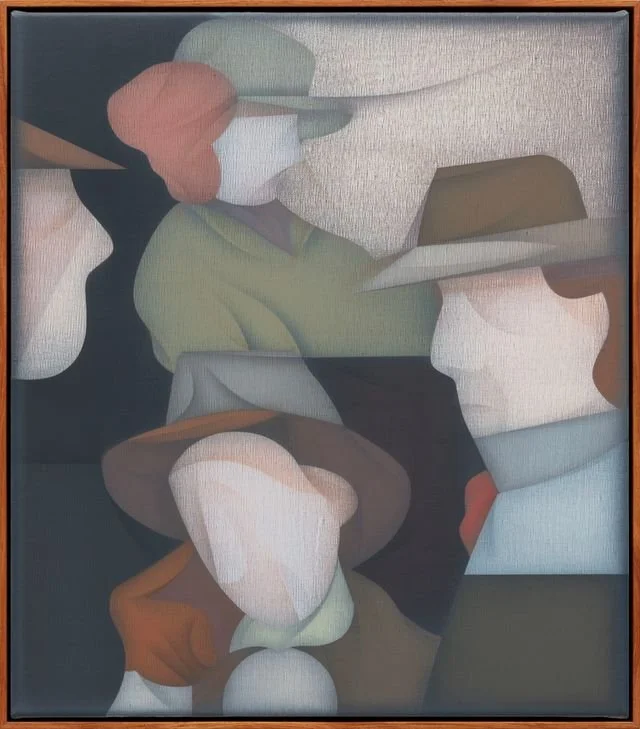
Mitch Cairns, Writer with Readers, 2025, oil on linen, private collection, Naarm/Melbourne, image courtesy the artist and The Commercial, Sydney © the artist, photograph: The Commercial
MS: Was there an important lesson you learned during your time at the National Art School? Was there a particular teacher whose advice has stayed with you?
MC: I had a lecturer called Kevin Malloy, and he was an American. His teaching was characterized by quietly spoken riddles. I leaned in—literally—to listen to him, but also leaned into everything he said. He would often leave you without a clear direction and say, “Do it again, make it again. If you’re not happy, do it again. Don’t settle for it. Just fix it or do it again.” If you are a young student, you don’t really want to be told to do it again. Everyone’s trying for a path of least resistance. So the idea of correction, or making corrections, is a tough, long lesson to learn. Look at it, understand it, what you like, what you don’t like, what doesn’t work, and don’t settle for something that you feel can be improved upon. In addition, I was often left wondering after one of our conversations. He was quite good as an educator because he left space for a student to occupy, rather than expecting deliverables.
MS: How would you describe the evolution of your practice across this survey, from early student works created on site to your most recent and newly commissioned pieces? Do you see a growing sense of maturity, or the influence of lived experience, emerging over time?
MC: The earliest works in the show are very direct. There’s a room with enamel paintings, ink paintings, and written works, and they’re quite bold. The more recent works, though, are much more labour-intensive. There’s a level of technicality in them that isn’t present in the earlier pieces. I guess what I’m trying to say is that I sort of accidentally became interested in technical development within my painting practice. I’m an extremely impatient person, so that’s not exactly a natural state for me to lean into. But I think I just do what the paintings ask of me, and that obviously requires presence, time, and patience. So there’s been a shift toward resolving technical problems, as much as there is ruminating on image-making or image construction.
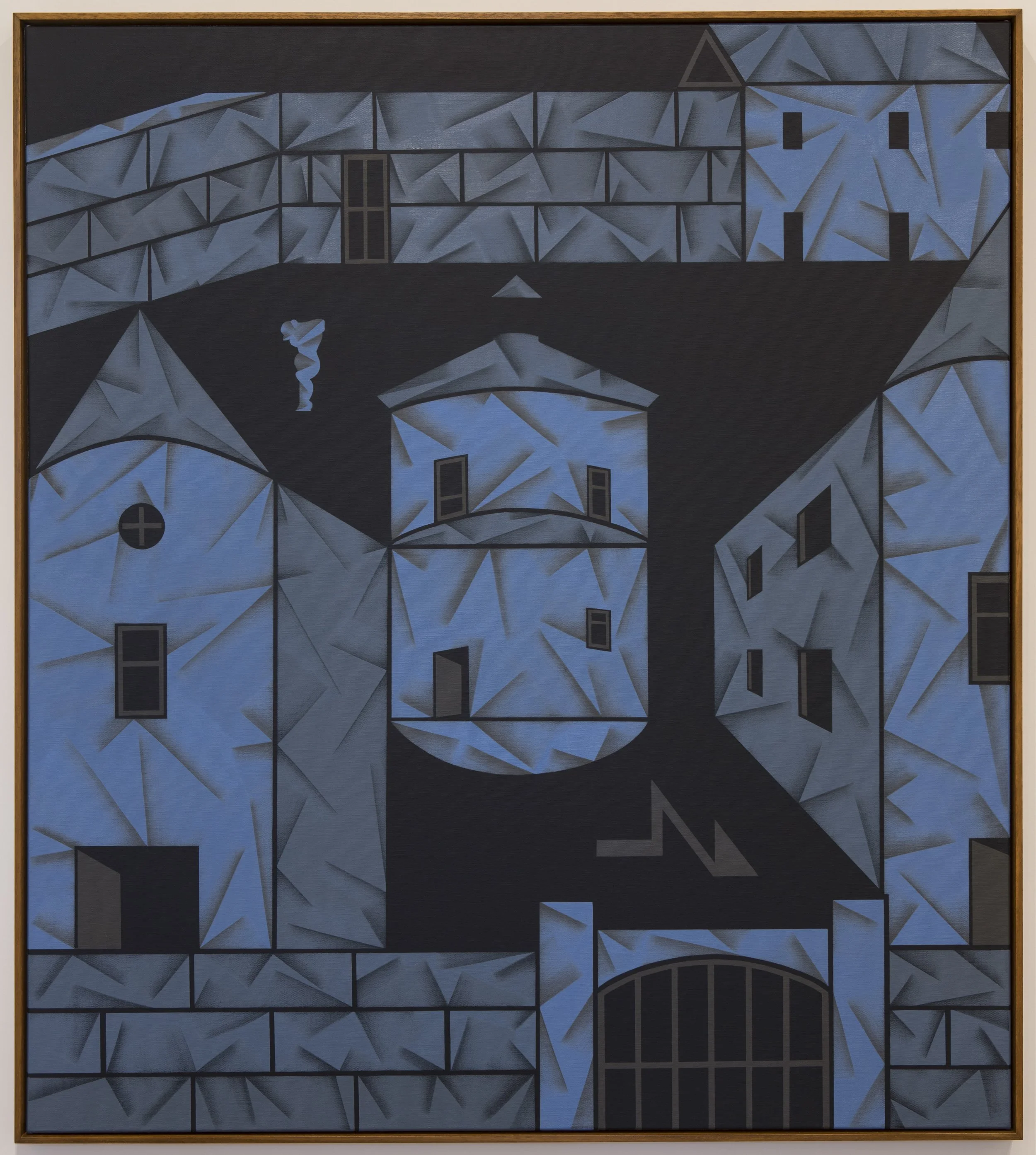
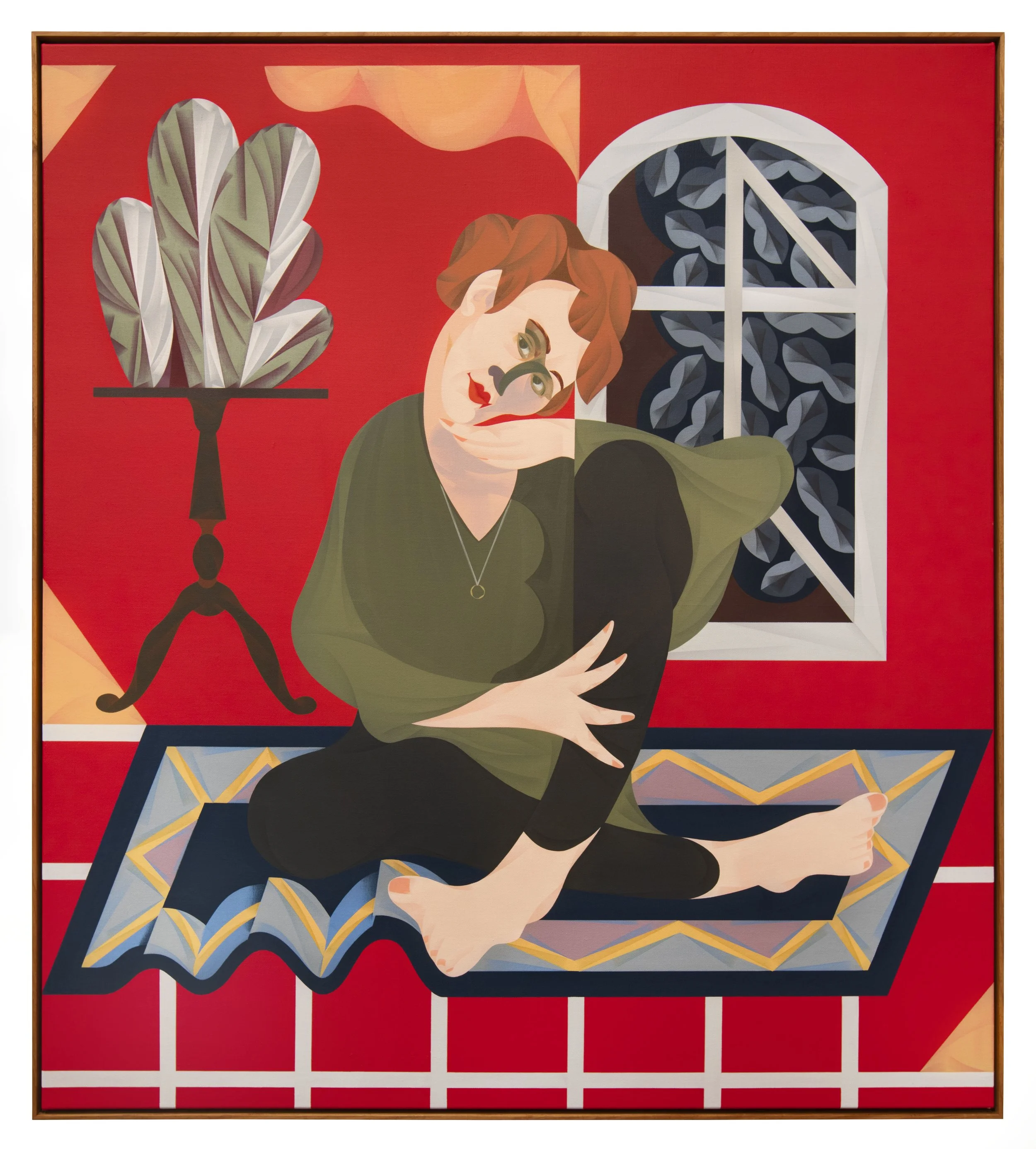
Left: Mitch Cairns, NAS, 2015, oil on linen, private collection, Kamberri/Canberra, image courtesy the artist and The Commercial, Sydney© the artist, photograph: JessicaMaurer. Right: Mitch Cairns, Agatha Gothe-Snape, 2017, oil on linen, Monash University Collection, purchased 2017, image courtesy the artist and Monash University Museum of Art ©the artist, photograph: Sofia Freeman/The Commercial.
MS: Do you think any conceptual themes have unexpectedly persisted or come to fruition as a result?
MC: I don’t know how successful artists are at siloing a felt response, a conceptual idea, or the material conditions of making. They all overlap. It’s like a Venn diagram, and it’s very hard to separate them. Even thinking about your previous question, we landed on this idea of technicality as a kind of driving impulse in the work. But that’s not really about what’s being painted, or even how an interest in word and image is explored. And yet, all of these elements are completely interdependent. They work together, sometimes in harmony, to move something forward.
MS: I appreciate that answer, that there isn’t a single driving motive, but rather something that unfolds in real time.
MC: To be honest, I’ve only ever made what I want to make. I’m very intuitive in that way. There have been times when I’ve questioned whether that way of working is something I can feel confident in, especially when so much art is built around very clear ideas about how it should be read, what it contains, and how it is meant to be understood. But I’ve never worked like that. I’ve always led with, this feels right, just do it. No one else is going to do it for me, so I have to follow that instinct. It’s really only with an opportunity like this exhibition that I can step back and assess that approach. But no, I’ve never adhered to a fixed program of making art. It’s simply the way I’ve instinctively felt I should work.
MS: Not many artists can include an Archibald Prize–winning portrait in their survey exhibition. What significance does this 2017 portrait of your partner and fellow artist, Agatha Gothe-Snape, hold for you and what chapter in your life and practice does it represent? Was intuition a driving force, as you’ve touched on?
MC: I started entering that prize because it was the only real forum in town for portraiture around, and it offers a kind of noble brief. It asks painters to make pictures of other people, and I love the simplicity of that. If you’re interested in images, portraiture is a very direct and generous framework to grapple with. I’m not sure I would have been making portraits if it weren’t for the Archibald Prize. That’s not to give it too much credit, it’s just that being a painter in Sydney, with the prize held annually at the state gallery, it’s very much part of the cultural fabric of the state, if not the country. It’s kind of a given. So sometimes the things that are already there to engage with become the most sensible options. It does give you the opportunity to think about who you want to paint, and in my case, that reflects something of my artistic and social world. That’s a nice thing to reflect on. Painting Agatha made a lot of sense. She’s my partner, but she’s also one of my favourite artists, still. The painting itself presented plenty of challenges. I don’t mean to suggest it was easy. I’m not trying to demystify it, but it wasn’t any more or less difficult than other paintings.
MS: When you see it in the context of the exhibition, it doesn’t feel like you changed your style or approach because of the prestige of the prize. It just reads as another work.
MC: Yeah, which I think is really cool. There are three or four portraits included, and while they’re identifiable as portraits, they still sit comfortably within the broader context of what I was making at the time. You can see them as part of a continuous way of working, rather than something separate.
MS: Do you think the art world lacks playfulness, humour, and wit? What value is there in provoking those kinds of responses through depictions of domestic and familial life?
MC: I’m not sure I have strong feelings about how the work gets described. You don’t really have control over that. I understand the point being made, but I don’t set out thinking, this will be a witty painting. Using what might be seen as everyday subject matter is just something I’ve always done. I didn’t come from an artistic family, and I didn’t have much exposure to art before going to art school. I think I found a pathway into it by responding to my immediate surroundings. I do value clarity, but I also follow what feels like a natural way into making. In a very traditional sense, it connects to established genres of painting, even if that’s not something I’m consciously trying to emphasise. I don’t mind there being a still life, a portrait, and a landscape, and all these traditional ways of making paintings, because in some ways that sort of does a little bit of the work for you. I’m happy to lean into a genre for the purposes of making a painting. Any sort of pre-existing condition will do in order to serve its making. So, I suppose there’s that side of it. And they have been reasonably good crutches in the advancement of making anything.
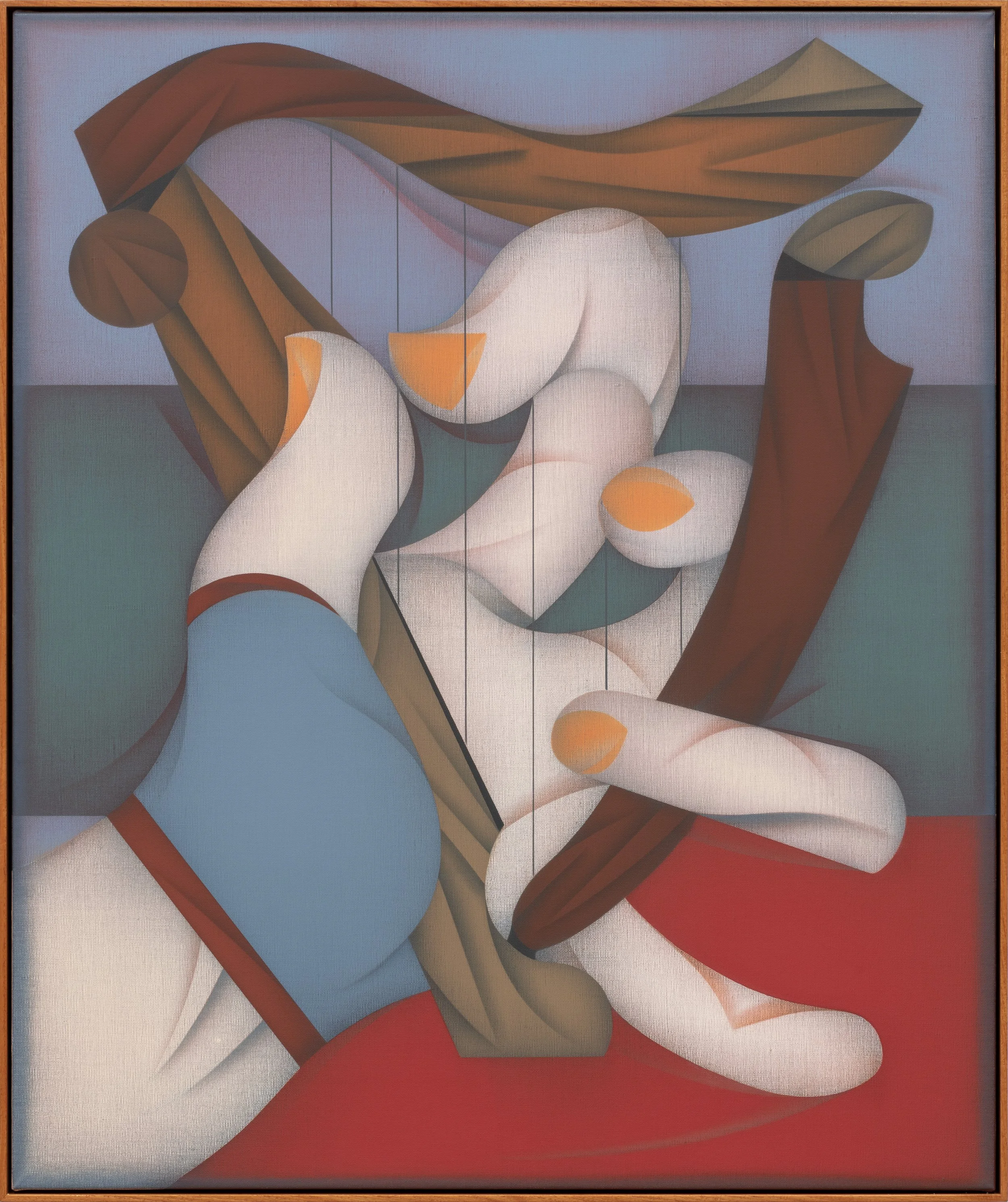
Mitch Cairns, Erato, 2025, oil on linen, private collection, Sydney, image courtesy theartist and The Commercial, Sydney © the artist, photograph: The Commercial
MS:Time is of the essence in a survey exhibition, particularly for Artist’s Mouth. Described as having a “modernist sensibility”, what is it about the Modernist movement that you wish to emulate, mediate, or expand upon?
MC: I don't think I'm doing any of those things. Before art school, I thought art was painting, and I thought painting was art. And Picasso was a painter, so he did Cubism, so Cubism was art. It has served me not to question some things too much. I'm very interested in modern movements, but I'm certainly not encyclopedic. And I certainly don't ever aim to be encyclopedic. It's just that I'm visually responding to a certain history of art. And I don't think you can expand on something that doesn't exist anymore. That’s the other thing. The moment is over. But I think that in the subjects used within Cubism, and within a lot of art forms, they are accessible. They are very domesticated scenes and those sorts of things. And if you are struggling with an understanding of what art is in its broadest sense, you do need some things to hang onto. Immediate surroundings have a place in art history, and they have a place in our everyday lives. I don't even mean to make too big a point of that, I'm just trying to think about what the attraction is. I mean, they are visually radical paintings. Cubism is one of the most radical developments in how we look at something. But I'm certainly no scholar or devotee or apologist for bad Cubism. I just think it's something that has been a constant for me.
I think the way someone looks and the way they are depicted are two totally different things. It could be realism, or it could be something else; it could be a doll, or even a physical door that is given your name, and we have to look at the door as if it were a portrait, for example. I just don’t have the patience or time for realism. I’m interested in contour. I’m interested in colour and tone. I’m interested in all the nuts and bolts that are required to make what would be deemed a successful painting. And those qualities are evident in every art form. It’s just that that particular period of work continues to be of some interest to me.
MS: Do you find yourself interested in something particular at the moment that you want to continue exploring?
MC: At the end of last year, I was awarded the Neil BNA Fellowship through the Mosman Art Gallery. That will allow me to travel to Scotland to visit Ian Hamilton Finlay’s garden sculpture, where he lived, called Little Sparta. There is a publication project and an exhibition that I am currently working on that incorporates that visit. I am sort of knee-deep in that project already. As the exhibition crystallises and then fades away, that is where I am standing.