
‘Mind Maps’ with LA-based Artist Naotaka Hiro
Words by Ashley Scott
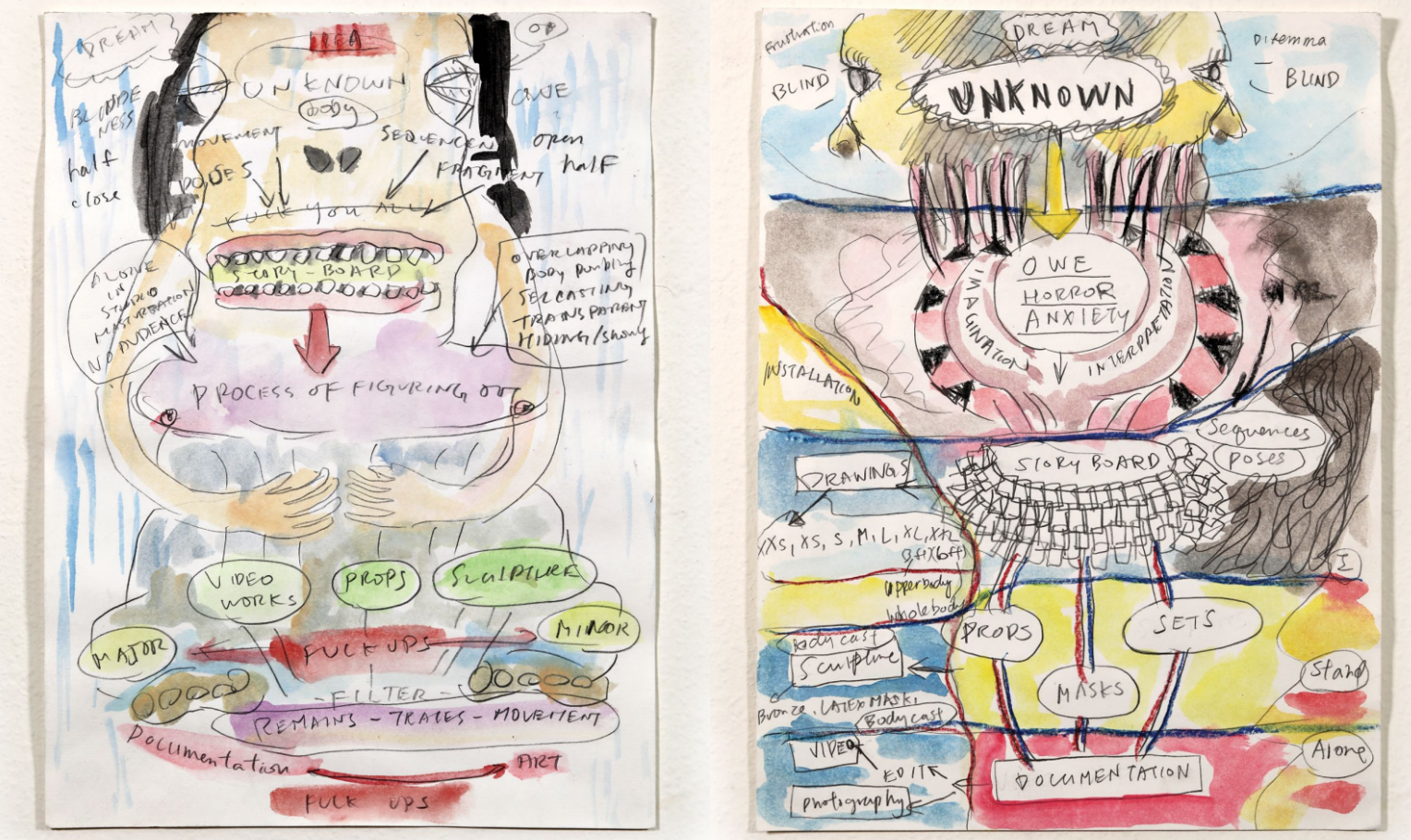
Courtesy of the artist
Naotaka Hiro is an artist whose approach to creativity plays out like two roles in a film, a dance between two actors, perhaps, or a director moulding the piece’s starring role. “My practice, whether drawing or painting, consists of two steps,” he explains. “The first step is more subjective, intuitive and organic, while the second is more objective and analytical. I repeat these steps several times, with two personas [that] continually agree and conflict throughout the process.” This two-step process leaves the viewer with colourful and dynamic abstract pieces that invite a deeper reading of the artist’s duality.
Working in his studio outside of Los Angeles, Hiro prefers a solitary approach to his creations: “My studio is in Baldwin Park, California, a city with a massive dam nearby and a very industrial feel. I don’t know if other artists live in the town, I tend to work alone in the studio all day,” he adds. “When I immigrated to the US at 18, I struggled with communicating in English and had difficulty asking collaborators, such as cast and crew, to participate in my films. As a result, I began to create one-person productions in which I acted and directed simultaneously,” Hiro says of his origins in the US and initial film interest.
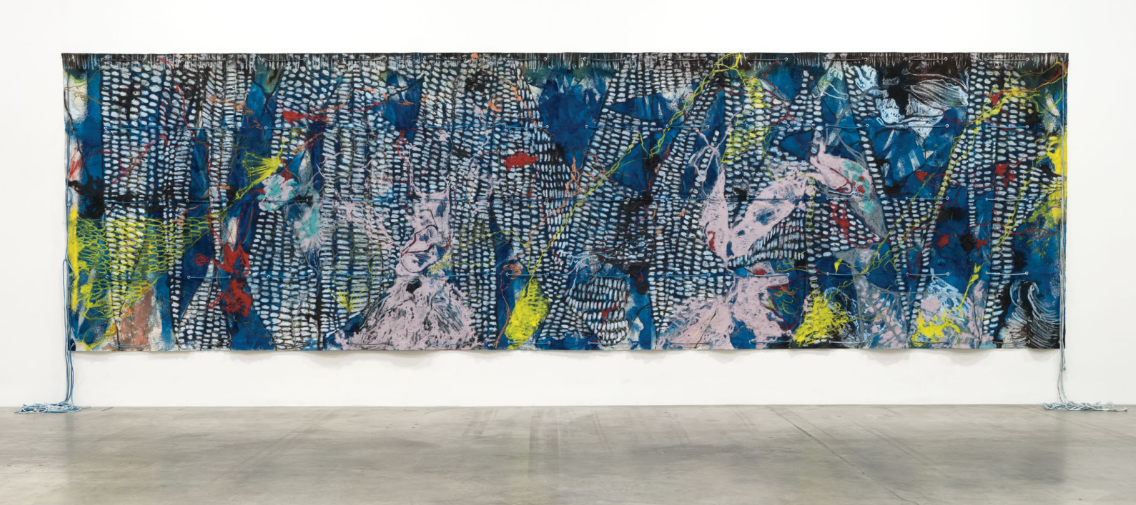
Naotaka Hiro, The Swimmer, 2024, canvas, fabric dye, oil stick, grommets, and rope 84”x276”. Photo: Fredrik Nilsen Studio, courtesy of the artist and The Box LA/ Misako & Rosen, Tokyo
His self-meditative successes have since grown, with his works featured in institutions such as the Whitney Museum of American Art and MoMA, where his pieces are exhibited in a room titled Painting Paintings, alongside work by Joan Mitchell and Ken Okiishi. “Artmaking is about encountering, elucidating, responding and documenting,” says Hiro. “The artwork is proof of the process, representing the residue of my body, its placement and movement.” Even as Hiro’s work ranges from the graphic arts to photographs and videos, the processes of drawing play a clear role in the creation of each of his works. Utilising the tools he enjoys most, he covers a wide array of materials to link to his core mind map of creating a work. Graphite, crayon, wax pencil, colour pencil, acrylic, and watercolour are featured regularly on various surfaces, including paper, canvas and wood panels.
The forms these take in the work can appear to the first-time viewer as quite abstract. Hiro, however, from his creative perspective, proves that each piece is ultimately quite meditative and thought through. “The dilemma of not knowing my body serves as a creative starting point, a space of unknown, blindness, and awe from which my imagination can emerge. It often begins with the body parts, leaving me fundamentally blind to the subject of an unknown world,” he elaborates on the theory being the works.
Building out this process for Hiro involves what he coins his ‘Mind Maps’, a way, he explains, to visually organise his art-making process, as well as his thoughts and emotions. “When I feel lost, I often create a diagram,” he adds. “By mapping out the different aspects, I can clarify the actions I’ve taken and understand where I currently stand. This diagram serves as a mental compass, so I refer to it as a ‘Mind Map’.”
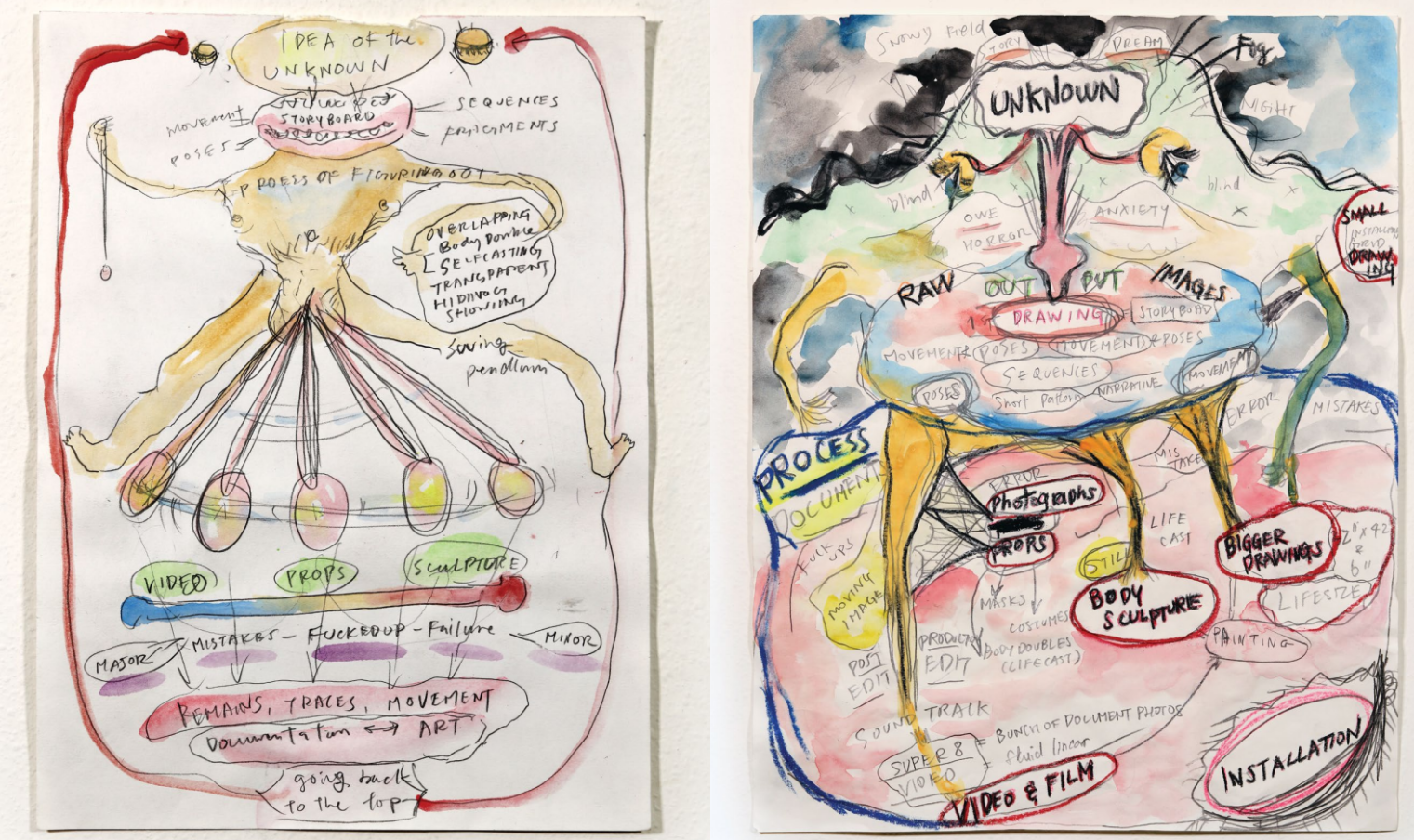
Courtesy of the artist
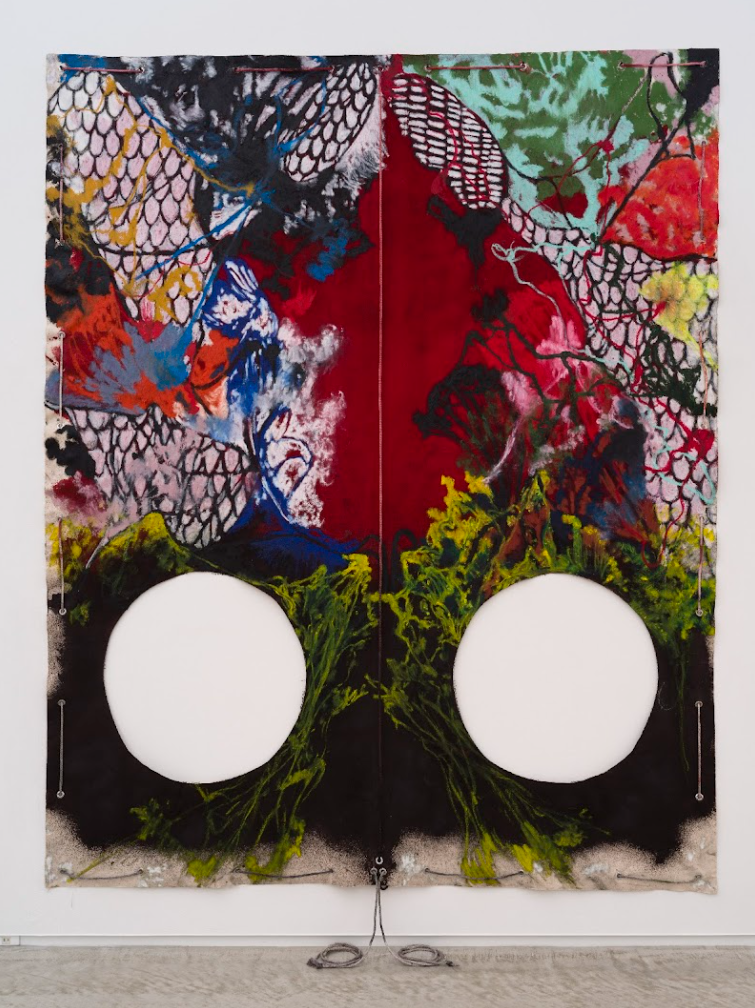
Naotaka Hiro, Untitled (Grandview), 2024, canvas, fabric dye, oil pastel, rope, and grommets, 103 inches x 84 inches, Photo: Naotaka Hiro, courtesy of the artist and Misako & Rosen, Tokyo
In discussing the use of self in his work, Hiro says that while the body features prominently as a starting point, he rarely uses his own visage in the final result. An early exception, a piece entitled Sand-Man and included in his 2022 solo show at New York gallery Bortolami, featured both his body and face in the cast sculpture, coming at a time of recent pandemic-induced crime against the Asian-American community.
“I talked with my friend during the pandemic, and she mentioned that many Asian-American artists rarely show their faces. I also realised that I rarely show my face, with a few exceptions,” Hiro explains. “I was interested in my body and wanted to avoid interpreting a specific cultural element in my work. Even though I use my body as a core element, I aim to keep the work anonymous.”
The idea of showing more of himself in the work, while core for some, felt like a significant step to Hiro. “I felt very uncomfortable seeing my face on my sculpture, but it made sense when I presented it in the space,” he shares of the experience. “This time, I felt the urge to show who I am after all the incidents during that period for my community.”