
Collier Schorr Talks to us about her Akerman Ballet Tome
Interview by Michelle Grey l Introduction by Lila Daly-Hyatt
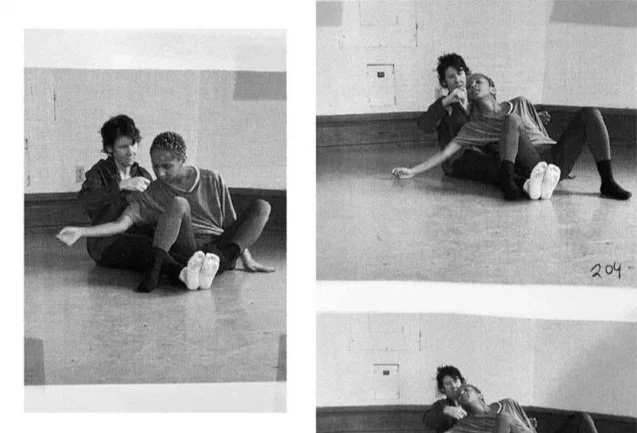
Images courtesy Collier Schorr and The Song Cave.
For photographer Collier Schorr, the movement of the body becomes a message, like writing a letter; an articulation of the self in dialogue with another. A New York-based photographer known for her sensitive portraits of adolescence, Schorr's latest project sees her own body become the subject.
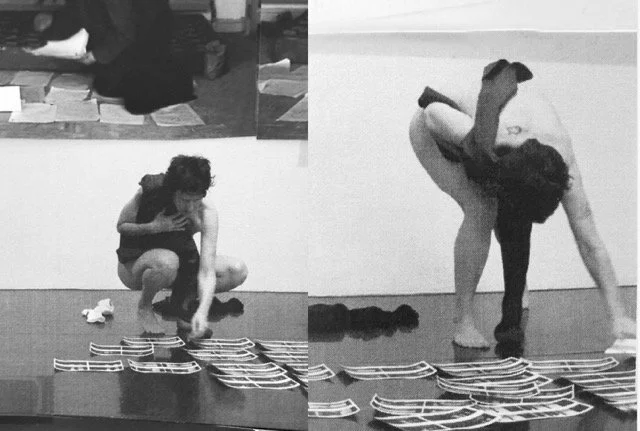
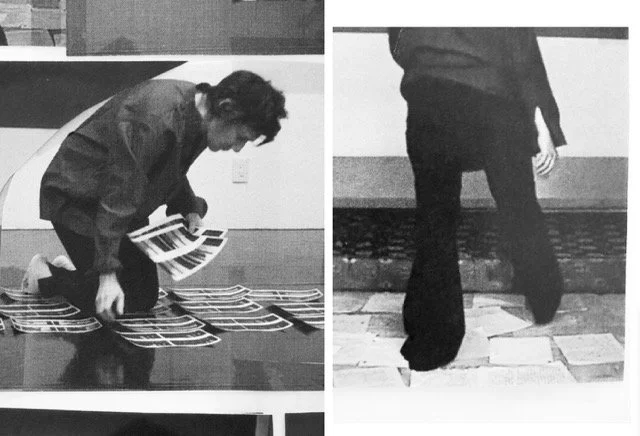
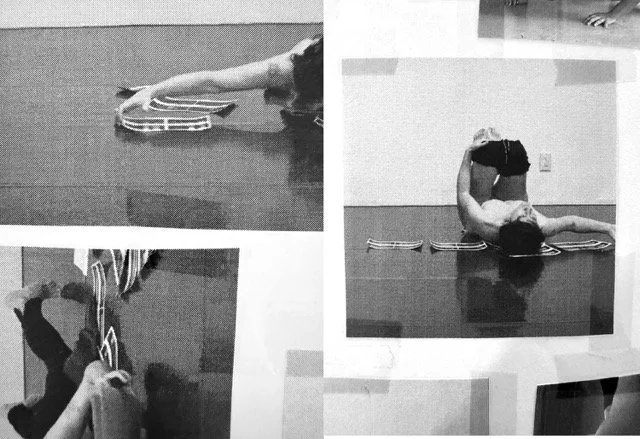
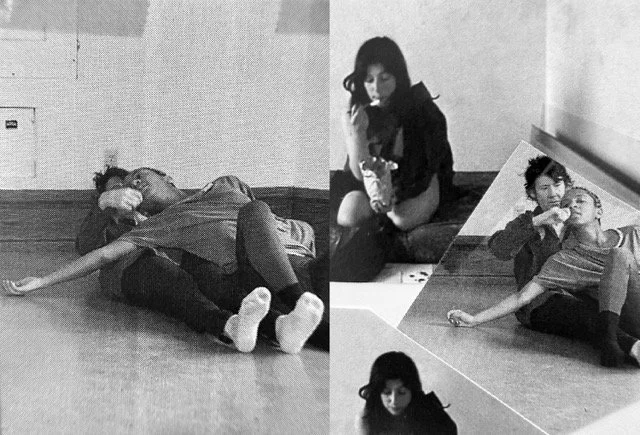
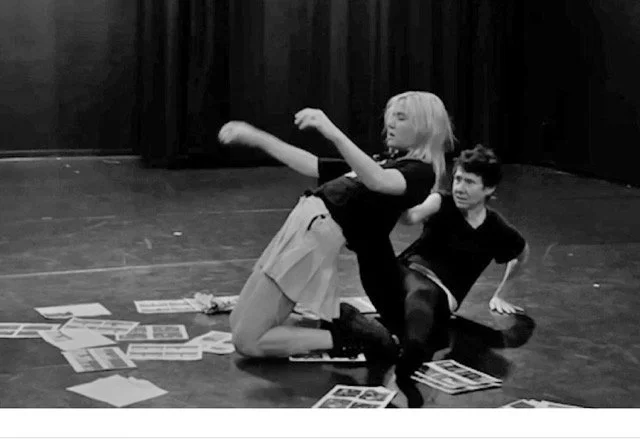
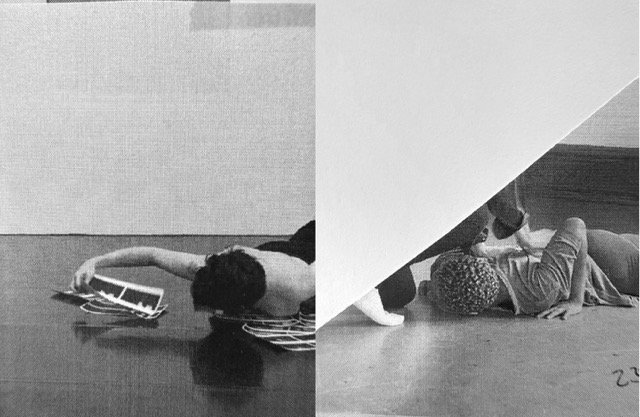
Alongside eight dancers, Schorr adapts artist and filmmaker Chantal Akerman’s first feature film, Je Tu Il Elle (1974), into a personal ballet. Recognised as a landmark work of queer cinema in its representation of female sexuality, the film opens with its protagonist, played by the director herself, writing a letter to her former lover. Like Akerman, Schorr steps in front of the camera as the lead in her own performance. Where Akerman’s protagonist processes her heartbreak through writing letters that she’ll never send, Schorr writes herself into being through the body. Working scene by scene, Schorr translates printed stills from Je Tu Il Elle into choreographed movements. Recently published in book form, Writing a Letter: Akerman Ballet, Act 1, brings together a sequence of film stills from the performance’s first act.
With images that take on a “ghostly texture”, Schorr dances between the spectral and the embodied, each step a dialogue between Akerman’s ghost and her own movement and muscle. Experimenting with the sense of exposure that comes with placing her own body in front of the camera, Schorr offers a poetics of visibility that reflects on queer histories, radical intimacies, errant bodies and repressed desires.
Following the release of Writing a Letter, A-M Journal speaks with Collier Schorr about performance as personal politics, stripping off signifiers, and the sheer audacity to exist where others have not been able.
MICHELLE GREY: You encountered Je Tu Il Elle when you were young, but returned to it decades later. Do you think we sometimes have to grow into the works of art that ultimately shape us?
COLLIER SCHORR: The film made a huge impression on me as a 20 year old who had only seen glimpses of a world that might include me. I recently saw Brandi Carlile perform and she was wearing a tie, and that simple act carried for me such a sense of nostalgia. It’s fun now to wear a tie, and when I was a kid it was a really major signifier. When you exist in and out of the popular culture things stick to you, but they can’t always be shown or shown off. So the question is deep for me, because as a queer teenager and young adult, influences were still secrets.
MG: You had a brief encounter with Akerman before a screening and have spoken about wishing you’d stayed longer. How much of this project is a continuation of a conversation you never got to have?
CS: Yes, maybe that’s why there is a ghostly texture to the images, and they feel that they are older than their years. Sometimes it is easier to have a conversation in one’s head. I do not think I could have really been myself in that talk unless she was interested in knowing me. So here the full exchange has a chance. I am heavily invested in her, but I am showing myself. Transposing. Idealising, moving in. Clawing my way through. Is it a pilgrimage? Yes and no.
I’m not in love and I don’t want to be her, but possibly I did want to. Possibly it was that I wanted a reflection that was already sanctioned by an art world, because of her talent and sheer audacity to exist where others had not been able. I do think having holocaust survivors as family propels you to exist, but then may also overwhelm you.
MG: Photography has allowed you to spend much of your career looking at other bodies. What happened when your own body became the material?
CS: There is a way that I fell in love with myself for the first time. Which would seem impossible if you asked me before I started. But it is that experiment of self love that is needed to exist as a work itself. What’s funny to me is that I have assigned clothes so much importance in my life, from high school on, as either a tool of transmission of my desire or a way to skip over my family’s origins or even a way to switch gender – but where I love myself begins when I am naked, when I dare to be stripped of those signifiers. Essential me. You know, it’s when you feel part of a tribe – not even an individual, but a carrier of DNA and potential.
MG: You became a dancer at 55. Did arriving at dance later in life give you a freedom you might not have had at 25?
CS: I danced in clubs at 25. At 55 I made my work, and dance was the medium. I had to do it. There was such a pleasure in physically making something. It was almost like building a house or a table. It felt that basic. I don’t even think I have achieved any more confidence dancing at a party. It’s a different kind of moving.
I learned it half in my lessons from Kade Pyle, and half in the wrestling room of Blair academy where I followed that team for a few years. I learned partnering in both places and learned to be physical and aggressive and tender and performative in both places, and so that’s what the dancing is.
MG: You’ve spoken about Yvonne Rainer in several interviews, and when we interviewed her for A-M Journal, she told us that she moved from choreography into filmmaking partly to engage more directly with feminism, sexuality and politics. Do you see Writing a Letter as a political work in its own way?
CS: I see it a personal politics – I can’t separate it. But I really understand that for Yvonne, she needed another form at some point to accommodate her new ideas, new desires, new concerns. It’s not that one form does more… it’s that another form adds more. For me, writing, photography, drawings, choreography, movements all circle a problem or a desire. Maybe, ultimately, an argument that needs to be staged? Yvonne needed talking and I needed to stop talking. And you can’t make photos without talking.
MG: You’ve said that this experience has changed you. In what ways?
CS: My body changed. That was the most surprising thing, to see my body have this new use, new muscles. And like all dancers, I aged, and it doesn’t feel like that anymore, but it did, and I have the footage.
I think also really collaborating with our artists physically, and partnering, changed me. The proof of someone else’s gifts was liberating because being an artist is, among other things, an extremely selfish endeavour. Even if it’s generous, I have always felt anxiety over what’s ‘mine’, and in this piece, yes it’s mine, but there is a lot of proof that it’s ours as well.
MG: What do you think it means to be an artist today, and have you seen this change throughout your career?
CS: I started out as a writer, which you could say is an artist, but to me it’s not. It’s writing, and that’s its own picnic and dark hole of loneliness. I feel more and more an artist the further away I am from the classic art world ecosystem. The less I show the more I make. I made art in the mid 80’s because my friends did and because I worked at 303 Gallery. And because that was a time in which you didn’t need to have a skill. You had to have a reason or agenda.
I wanted to make images that spoke to my own existence as queer 23 year old with very few role models. It was mostly about free speech. It was not about a career, and the art world at the time supported that notion. I supported myself amazingly throughout the 90’s making exhibitions. And then I merged fashion photography into my practice, continuing the idea of putting images into the world that reflected my existence. I think I move where I feel my blood beat – how James Baldwin described his desire and sexual identity. It’s lovely to feel the options.